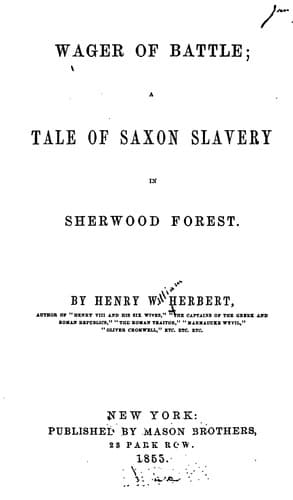
Wager of Battle: A Tale of Saxon Slavery in Sherwood ForestHerbert, Henry William
History
Wager of Battle: A Tale of Saxon Slavery in Sherwood Forest
Herbert, Henry William
Anglo-Saxons -- Fiction; Great Britain -- History -- Norman period, 1066-1154 -- Fiction; Sherwood Forest (England) -- Fiction
"That, to teach thee manners. Now, then, bring him along, men; set him
on the black gelding, chain his legs fast under the brute's belly,
ride one of you at each side, and dash his brains out with your axes
if he look like escaping. Away! away! I would be at Kendal before they
ring the prime,[5] and at Lonsdale before matins.[6] So shall we be
well among the Yorkshire fells before daybreak."
[5] Prime was the first service, and began the instant
midnight had sounded.
[6] Matins was the second service, at 3 A.M.
His words were obeyed without demur or delay, and within five minutes
the Saxon was chained on the back of a vicious, ill-conditioned brute,
with a savage ruffian on either side, glaring at him through the bars
of their visors, as if they desired no better than a chance to brain
him, in obedience with orders; and the whole party, their horses being
quite fresh, were thundering down the dale at a pace that would bring
them to Kendal long enough before midnight.
CHAPTER XXII.
THE SHERIFF.
"The Sheriff, with a monstrous watch, is at the door."
KING HENRY IV.
Two hours' hard riding, considering that the riders were men armed in
heavy mail, brought the party into the narrow, ill-paved streets of
Kendal, at least two hours earlier than the time specified by Sir
Foulke d'Oilly, and it was not above ten o'clock of the night when
they pulled up before a long, low, thatched cabin, above the door of
which, a bush and a bottle, suspended from a pole, gave note that it
was a house of entertainment. Flinging his rein to one of half-a-dozen
grooms and horse-boys, who were lounging about the gate, the knight
raised the latch, and entered a long, smoky apartment, which seemed to
occupy the whole ground floor of the building, affording room for the
accommodation of fifty or sixty guests, on occasion of feasts, fairs,
or holidays.
It was an area of thirty or forty feet in length, by ten or twelve in
width, with bare rough-cast walls, and bare rafters overhead,
blackened by the smoke which escaped from the ill-constructed chimneys
at either end, and eddied overhead in a perennial canopy of sable. The
floor, however, was strewed with fresh green rushes, green wreaths and
branches were hung on the rough-cast walls, and a large earthen-vase
or two of water-lilies and other showy wild-flowers adorned the board,
which was covered with clean white napery of domestic fabric. At the
upper end of this long table, half-a-dozen or eight men were supping
on a chine of hill-kid, with roasted moor-fowl and wild-ducks, the
landlord of the tavern being the bailiff of the town, and having his
lord's license to take all small game, save bustard, heron, woodcock,
and pheasant, for the benefit of his guest-table.
On the entrance of Sir Foulke, these men rose to their feet; and one,
the best-armed and best-looking of the party, seeming to be a second
esquire or equerry, asked him, in a subdued voice--
Public-domain text, read in full here on John Shaqi.
Reviews
Reviews
No reviews yet
Be the first to share your thoughts on this work.
Elsewhere in the archive
Join the Discussion
Join the discussion
Sign in to leave a comment or review.
Sign InorCreate an account