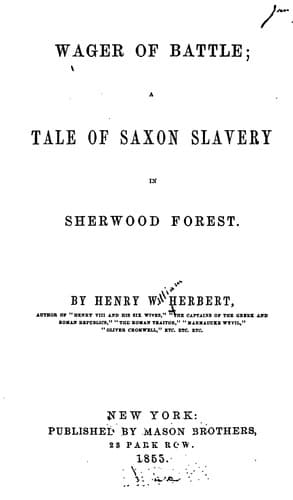
Wager of Battle: A Tale of Saxon Slavery in Sherwood ForestHerbert, Henry William
History
Wager of Battle: A Tale of Saxon Slavery in Sherwood Forest
Herbert, Henry William
Anglo-Saxons -- Fiction; Great Britain -- History -- Norman period, 1066-1154 -- Fiction; Sherwood Forest (England) -- Fiction
There is nothing in all the reign of that wise, moderate, and able
prince, as viewed according to the circumstances of his position and
the intelligence of his era, the Second Henry of England, so
remarkable, or in his character so praiseworthy, as his efforts to
establish a perfect system both of judiciary power and of justice
throughout England. In these efforts he more than mediately succeeded;
and, although some corruptions continued to exist, and some instances
of malfeasance to occur, owing in some degree to the king's own
avaricious temperament and willingness to commute punishments, and
perhaps, at times, even prosecutions, for pecuniary fines, justice was
not for many centuries more equitably administered, certainly not four
hundred years afterward, in the reign of the eighth monarch of the
same Christian name, than in the latter portion of the twelfth
century.
At this period, that justly celebrated lawyer, Ranulf de Glanville,
was High Justiciary of England, besides holding the especial duty of
administering justice, at the head of five others, in the circuit
courts of all the counties north of the Trent; and he has left it on
record "that there was not now in the King's Court one judge, who
dared swerve from the path of justice, or to pronounce an opinion
inconsistent with truth."
During the six weeks, which intervened between the liberation of
Kenric from the arrest of Sir Foulke d'Oilly, and the day appointed
for the holding of the Lancaster assizes, there was great tribulation
in the castle of Hawkshead; and it was known that Sir Yvo de
Taillebois was in constant correspondence with the High Justiciary;
flying posts were coming and going, night and day, booted and spurred,
through rain or shine, from York, the present abode of Sir Ranulf, to
the shores of Windermere.
The old chaplain was buried up to the eyes in old parchments and
genealogies; and, to complete the mystery, Clarencieux, king-at-arms,
came down to the castle, accompanied by a pursuivant, loaded with
documents from the college of heralds, a fortnight before the decisive
day, and tarried at the castle until the time came, no one knowing
especially, save Sir Yvo, his daughter, Aradas de Ratcliffe, and the
persons employed in the research, what was the matter at issue.
Necessary, however, as it was deemed, at that time, to hold the
proceedings and their cause in perfect secrecy, no such reason exists
now; and it may be stated that, the object being no other than to
bring Sir Foulke d'Oilly to justice for the murder of Sir Philip de
Morville, it was necessary to be prepared at every point.
Now, according to the criminal law of that day, no prosecutor could
put in his charge for murder, until he should have proved himself to
be of the blood of the deceased. And this it was now the object of Sir
Yvo to do, there having always been a traditionary belief in a remote
kindred between the two families, though the exact point and period
were forgotten.
Public-domain text, read in full here on John Shaqi.
Reviews
Reviews
No reviews yet
Be the first to share your thoughts on this work.
Elsewhere in the archive
Join the Discussion
Join the discussion
Sign in to leave a comment or review.
Sign InorCreate an account