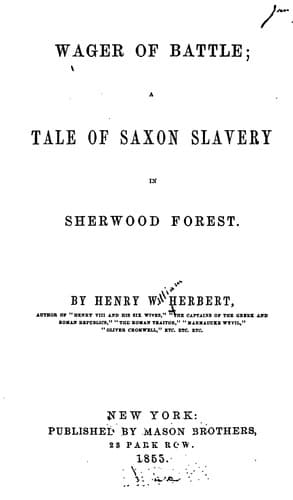
Wager of Battle: A Tale of Saxon Slavery in Sherwood ForestHerbert, Henry William
History
Wager of Battle: A Tale of Saxon Slavery in Sherwood Forest
Herbert, Henry William
Anglo-Saxons -- Fiction; Great Britain -- History -- Norman period, 1066-1154 -- Fiction; Sherwood Forest (England) -- Fiction
At this point, not a person in the court, from the lowest spectator to
the high justiciary on the bench, but believed the case to be entirely
made out; and some of the crown lawyers whispered among themselves,
wondering why the prisoner had not been arraigned in the forest or
criminal courts, for the higher offenses, which seemed to be proved
against him.
Thomas de Curthose, cross-examining the witness, asked--
"The man at the bar is Eadwulf the Red?"
"He is."
"On your oath, and of your own knowledge."
"On my oath, and of my own knowledge."
"Did you ever hear that 'Eadwulf the Red' should call himself, or be
called by others, 'Kenric.'"
"Never, until now."
"And how have you heard it now?"
"I have seen it stamped on his quarrels."
"Had 'Eadwulf the Red' a brother?"
"A brother?"
"Had 'Eadwulf the Red' a brother?"
"I have heard say he had."
"Of your own knowledge, on your oath?"
"He had a brother."
"What was his name?"
"I--I have forgotten."
"On your oath! on your oath, sirrah!" thundered Thomas de Curthose.
"Was not his name 'Kenric?'"
"I think it was 'Kenric.'"
"Look at the person at the bar." The man did so; but reluctantly, and
with an evident tremor.
"Is not that man 'Kenric,' the brother of 'Eadwulf the Red?'"
"That man is 'Eadwulf the Red'--I have sworn it."
"And art forsworn, in swearing it. But again, thou hast sworn, 'that
on the third morning, after taking scent of the fugitive from the
place of the deer and manslaying, and after hunting him constantly
with bloodhounds, you lost all track of him on the bare moor in
Borland Forest?'"
"Why, ay! I have sworn that; it is quite true," said the man,
seemingly reassured, at the change of the line of examination.
"I doubt it not. Now, when did the hounds take the scent again?"
"Why, not at all. We saw he was making for the sands, and so
squandered ourselves in parties, and on the second morning, at
daybreak, saw him crossing them."
"How far off was he, when you saw him?"
"About three miles."
"Could you see, to know him, at that distance?"
"Why, no; but we guessed it was he, when we saw him run from us; and,
when we wound up the clew to the end, and caught him, we found that we
were right."
"You may stand down. Who is next?"
Four other witnesses followed, who all swore positively to the person
of the prisoner, as "Eadwulf the Red," and testified to various points
in the circumstances of the pursuit and capture, all tending to the
identification of Kenric with the fugitive; and though the counsel for
the defense had succeeded, more or less, in shaking the credit of some
of the witnesses with the jury, and of raising a doubt concerning the
existence of a brother, with whom the fugitive might have been
confounded, no head had yet been made against the direct testimony of
six witnesses, swearing positively to his person, and against the
damaging circumstantial evidence of the crossbow and quarrels.
Public-domain text, read in full here on John Shaqi.
Reviews
Reviews
No reviews yet
Be the first to share your thoughts on this work.
Elsewhere in the archive
Join the Discussion
Join the discussion
Sign in to leave a comment or review.
Sign InorCreate an account