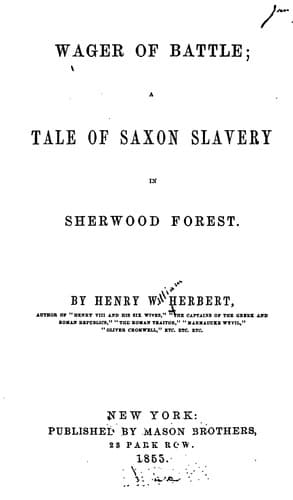
Wager of Battle: A Tale of Saxon Slavery in Sherwood ForestHerbert, Henry William
History
Wager of Battle: A Tale of Saxon Slavery in Sherwood Forest
Herbert, Henry William
Anglo-Saxons -- Fiction; Great Britain -- History -- Norman period, 1066-1154 -- Fiction; Sherwood Forest (England) -- Fiction
"It is scarce necessary that I should say any thing to this jury,
seeing that if the evidence of Sir Yvo de Taillebois be received as
credible, the case is at an end. But I would say that, without his
testimony, the defense might have rested safely, when they had shown
that the alleged fugitive, 'Kenric,' was a resident here in
Westmoreland, on the day, and long before the day, when he is charged
on oath to have been a serf in Yorkshire. For if A claim a horse, now
in the possession of B, swearing, and bring in witnesses to swear,
that he, A, lost, or had stolen from him, the said horse, on such a
day; and B bring sufficient and true witnesses to satisfy the jury
that the said horse, so claimed was in his, B's, possession, days,
weeks, or months before the 'such a day' on which A avers to have lost
or had the said horse stolen from him--then it is to be presumed, not
that A and his witnesses are mistaken as to the day, on which the
horse was lost, seeing that he and they have sworn positively to the
day, and that it is in him and them, alone, and on no others, truly to
know the day on which the said horse was lost or stolen--but that the
horse is another horse altogether, and not that horse lost or stolen
on the day averred; inasmuch as this horse claimed was, on that day,
and theretofore and thereafter, standing here, and could not therefore
be lost or stolen elsewhere. This is the law, gentlemen, of an ox, or
an ass, or a goat, or a piece of furniture, or of any thing that is
property, dead or living. Much more so, therefore, of the liberty of a
man. For God forbid that on this earth of England the liberty of a
man, which is even the dearest thing he hath on earth, should be more
lightly jeoparded, or less securely guaranteed to him, than the value
of his ox, or his ass, or his goat, or his chattel, whatsoever it may
be, that is claimed of him. And now, gentlemen of the jury, I will
detain you no longer. You may retire, if you wish to deliberate on
your verdict, whether the person at the bar be 'Eadwulf the Red,'
gross thrall of Sir Foulke d'Oilly, or 'Kenric the Dark,' and a true
freeman."
"So please the court, we are agreed," was the unanimous answer of the
jurymen.
"And how will you render your verdict?"
"By our foreman, Sir Ralph Egerton, of Egerton."
"We find," said the foreman, in answer to the eye of the justiciary,
"that the person at the bar, 'Kenric, surnamed the Dark,' is a free
man, and that Sir Foulke d'Oilly hath no claim against his liberty or
person. And we farther recommend that the witnesses for the plaintiff,
more especially Ralph Brito, and Andrew of Spyinghow, be taken into
custody, and held to answer to a charge of perjury."
Public-domain text, read in full here on John Shaqi.
Reviews
Reviews
No reviews yet
Be the first to share your thoughts on this work.
Elsewhere in the archive
Join the Discussion
Join the discussion
Sign in to leave a comment or review.
Sign InorCreate an account