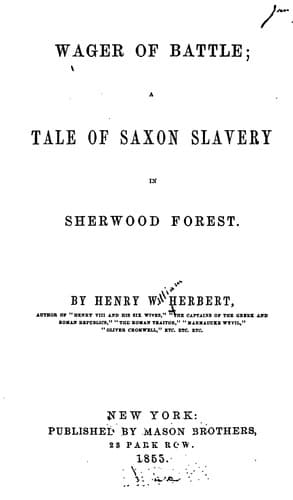
Wager of Battle: A Tale of Saxon Slavery in Sherwood ForestHerbert, Henry William
History
Wager of Battle: A Tale of Saxon Slavery in Sherwood Forest
Herbert, Henry William
Anglo-Saxons -- Fiction; Great Britain -- History -- Norman period, 1066-1154 -- Fiction; Sherwood Forest (England) -- Fiction
Meanwhile, two of the pursuivants, in waiting on Clarencieux, had made
their way to Sir Foulke d'Oilly, and whispered something in his ear,
which, whatever it was, made him turn as pale as death, and sink down
into his seat, without saying a word, while the pursuivants remained
standing at his back. The nobles and knights of his train looked at
him, and looked at one another, with troubled glances; but, finding no
solution to their doubts or answer to their question, seated
themselves in sullen discontent.
The multitude which filled the court-house, meantime, was in the
wildest state of confusion and consternation; the call for the
military force had struck terror into all, especially the feebler part
of the crowd, the aged persons and women, many of whom were present;
for none knew, in those stormy times, how soon swords might be drawn
in the court itself or the hall cleared by a volley of cloth-yard
arrows from the sheriff's Kendal archers.
After a while, however, by the exertions of the proper officers, order
was restored; and then, as if nothing had occurred to interrupt the
thread of his thoughts, de Glanville continued in the matter of
Kenric, who still waited in custody of the sheriff's officers.
"Be there any other charges against this man, Kenric, beside this one
of murder?"
"One of deer-killing, my lord, against the statute, in the forest
court, at the same time, and in the same place, as stated yesterday."
"And on the same evidence, doubtless, on which the jury pronounced
yesterday. In fact, there can be no other. In the last charge, who is
the prosecutor?"
"Sir Foulke d'Oilly, my lord."
"Ah! Sir Foulke d'Oilly! Sir Foulke d'Oilly!" cried Sir Ranulf,
looking lightnings at him, and then turning to the clerk. "Well, sir.
This matter is not as yet in the province of this court. Let it go to
the grand jury now in session, and see that they have copies of the
warrants, and full minutes of all the evidence rendered in the case
_de nativo_, and of the jury's finding, that they may have the
power to judge if these charges be not purely malicious."
A solemn pause followed, full of grave expectation, while the officers
were removing Kenric from the hall, and while the high-justiciary, his
assessors on the bench, the high-constable, the earl mareschal, and
the sheriff of the county were engaged in close consultation.
At the end of this conference, the high-sheriff formally appointed Sir
Hugo le Norman to be his deputy, with full powers, by the consent of
the court, invested him with his chain and staff of office, and,
shortly afterward, appeared in his private capacity, in the body of
the hall; and it was now observed, which had not been noticed while he
wore his robes of his office, that he carried his right arm in a
sling, and halted considerably in his gait, as if from a recent
injury.
"Stand forward, now, Sir Foulke d'Oilly," exclaimed the justiciary.
"Crier, call Sir Foulke d'Oilly into court."
Public-domain text, read in full here on John Shaqi.
Reviews
Reviews
No reviews yet
Be the first to share your thoughts on this work.
Elsewhere in the archive
Join the Discussion
Join the discussion
Sign in to leave a comment or review.
Sign InorCreate an account