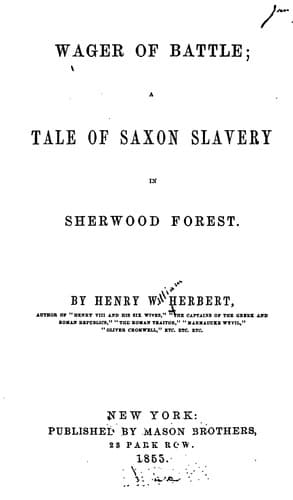
Wager of Battle: A Tale of Saxon Slavery in Sherwood ForestHerbert, Henry William
History
Wager of Battle: A Tale of Saxon Slavery in Sherwood Forest
Herbert, Henry William
Anglo-Saxons -- Fiction; Great Britain -- History -- Norman period, 1066-1154 -- Fiction; Sherwood Forest (England) -- Fiction
There being then two classes of serfs existing on British soil, though
not recognized as different by law, or in any wise differing in
condition, Kenric, himself descended in the third degree from a
freeman and landholder, exhibited a fair specimen at the first;
although it by no means followed of course that men in his relative
position were actually superior to the progeny of those, who could
designate no point before which their ancestors were free. And this
became evident, at once, to those who looked at the characters of
Kenric the Dark, and Eadwulf the Red, of whom the former was in all
respects a man of sterling qualities, frank, bold demeanor, and all
the finer characteristics of independent, hardy, English manhood;
while the second, though his own brother, was a rude, sullen,
thankless, spiritless, obstinate churl, with nothing of the man,
except his sordid, sensual appetites, and every thing of the beast,
except his tameless pride and indomitable freedom.
It was, therefore, even with one of the better class of these
unfortunate men, a matter of personal character and temper, whether he
retained something of the relative superiority he bore to his yet more
unfortunate companions in slavery, or whether he sank self-lowered to
their level. Nothing, it is true, had either to which he might aspire;
no hope of bettering his condition; no chance of rising in the scale
of humanity. Acts of emancipation, as rewards of personal service, had
been rare even among the Saxons, since, the utmost personal service
being due by the thrall to his lord, no act of personal service,
unless in most extreme cases, could be esteemed a merit; and such
serfs as owed their freedom to the voluntary commiseration of their
owners, owed it, in the great majority of cases, to their superstition
rather than to their mercy, and were liberated on the deathbed, when
they could serve their masters in no otherwise, than in becoming an
atonement for their sins, and smoothing their path through purgatory
to paradise.
With the Normans, the chance of liberation was diminished an
hundred-fold; for the degraded race, held in utter abhorrence and
contempt, and looked upon as scarce superior to the abject Jew, was
excluded from all personal contact with their haughty lords, who
rarely so much as knew them by sight or by name--was incapable of
serving them directly, in the most menial capacity--and, therefore,
could hardly, by the wildest good fortune, hope for a chance of
attracting even observation, much less such praise as would be like to
induce the high boon of liberty.
Public-domain text, read in full here on John Shaqi.
Reviews
Reviews
No reviews yet
Be the first to share your thoughts on this work.
Join the Discussion
Join the discussion
Sign in to leave a comment or review.
Sign InorCreate an account