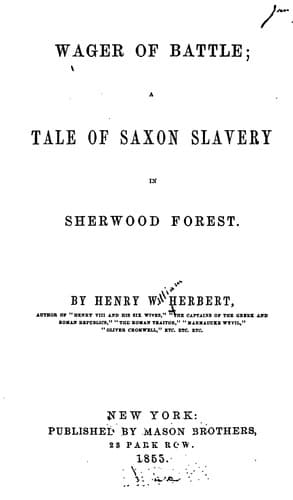
Wager of Battle: A Tale of Saxon Slavery in Sherwood Forest — John Shaqi
Wager of Battle: A Tale of Saxon Slavery in Sherwood ForestHerbert, Henry William
History
Wager of Battle: A Tale of Saxon Slavery in Sherwood Forest
Herbert, Henry William
Anglo-Saxons -- Fiction; Great Britain -- History -- Norman period, 1066-1154 -- Fiction; Sherwood Forest (England) -- Fiction
Again, on the deathbed, the Norman knight or noble, scarce
condescending to think of his serf as a human being, could never have
entertained so preposterous an idea, as that the better or worse
usage, nay! even the life or death of hundreds of these despised
wretches could weigh either for him or against him, before the throne
of grace. So that the deathbed emancipations, which had been so
frequent before the conquest, and which were recommended and
inculcated by abbots and prelates, while abbots and prelates were of
Saxon blood, as acts acceptable on high, now that the high clergy,
like the high barons of the realm, were strangers to the children of
the soil, had fallen into almost absolute disuse.
In fact, in the twelfth century, the Saxon serf-born man had little
more chance of acquiring his freedom, than an English peasant of the
present day has of becoming a temporal or spiritual peer of the realm;
and, lacking all object for emulation or exertion, these men too often
justified the total indifference with which they were looked upon by
the owners of the soil. This fact, or rather this condition of things
in their physical and moral aspect, has been dwelt upon, somewhat at
length, in order to show how it is possible that a gentleman of the
highest birth, of intellects, acquirements, ideas of justice and
right, vastly more correct than those entertained by the majority of
his caste--a gentleman, sensitive, courteous, kindly, the very mirror
of faith and honor--should have distorted devotion so noble, faith so
disinterested, a sense of honor so high, a piety so pure, as that
displayed by Kenric the Dark, in his refusal of the bright jewel
liberty, in his eloquent assertion of his rights, his sympathies, his
spiritual essence as a man, into an act of _outrecuidance_, almost
into a personal affront to his own dignity. Yet, so it was, and alas!
naturally so--for so little was he, or any of his fellows, used to
consider his serf in the light of an arguing, thinking, responsible
being, that probably Balaam was but little more astonished when his
ass turned round on him and spoke, than was Yvo de Taillebois, when
the serf of the soil stood up in his simple dignity as a man, and
refused to be free, unless those he loved, whom it was his duty to
support, cherish, shield, and comfort, might be free together with
him. Certain it is, that he left the cottage which he had entered
full of gratitude, and eager to be the bearer of good tidings,
disappointed, exasperated against Kenric, vexed that his endeavors to
prove his gratitude had been frustrated, and equally uncertain how he
should disclose the unwelcome tidings to his daughter, and how
reconcile to his host the conduct of the Saxon, which he had remained
in the hope of fathoming, and explaining to his satisfaction.
Public-domain text, read in full here on John Shaqi.
Reviews
Reviews
No reviews yet
Be the first to share your thoughts on this work.
Join the Discussion
Join the discussion
Sign in to leave a comment or review.
Sign InorCreate an account