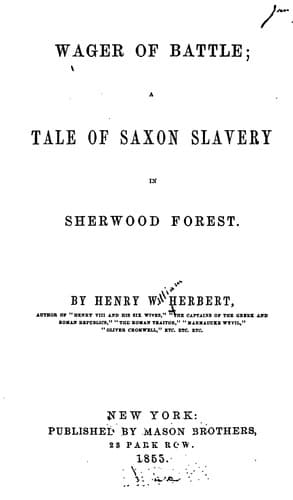
Wager of Battle: A Tale of Saxon Slavery in Sherwood ForestHerbert, Henry William
History
Wager of Battle: A Tale of Saxon Slavery in Sherwood Forest
Herbert, Henry William
Anglo-Saxons -- Fiction; Great Britain -- History -- Norman period, 1066-1154 -- Fiction; Sherwood Forest (England) -- Fiction
The generally good and kind-hearted man, who has all his life been
used to see his beasts of burden dragging a few pounds' weight above
their proper and merciful load, soon comes to regard the extraordinary
measure as the proper burden, and to look upon the hapless brute,
which is pining away by inches, in imperceptible and insensible decay,
as merely performing the work, and filling the station, to perform and
fill which it was created. And so, and yet more fatally, as regards
the subjugation of man, or a class of men, to man. We commence by
degrading, and end by thinking of him as of one naturally degraded. We
reduce him to the standard and condition of a brute, then assume that
he is but a brute in feelings, intellect, capacity to acquire, and
thence argue--in the narrowest of circles--that being but a brute, it
is but right and natural to deal with him as what he is. Nor is this
tendency of the human mind limited in its operation to actual slavery;
but prevails, more or less, in relation to all servitude and
inferiority, voluntary or involuntary; so that many of the best, all
indeed but the very best, among us, come in the end to look upon all,
placed by circumstances and society in inferior positions, as
inferiors in very deed, and as naturally unequal to themselves in
every capacity, even that of enjoyment, and to regard them, in fact,
as a subordinate class of animals and beings of a lower range of
creation.
This again, still working in a circle, tends really to lower the
inferior person; and, by the tendency of association, the inferior
class; until degenerating still, as must occur, from sire to son,
through centuries, the race itself sinks from social into natural
degradation.
This had already occurred in a very great degree in the Saxon serfs of
England, who had been slaves of Saxons, for many centuries, before the
arrival of the Norman conquerors. The latter made but small
distinction, in general, between the free-born and the slave of the
conquered race, but reduced them all to one common state of misery and
real or quasi-servitude--for many, who had once been land-holders and
masters, sunk into a state of want and suffering so pitiable and so
abject, that, generation succeeding generation with neither the means
nor the ambition to rise, they became almost undistinguishable from
the original serfs, and in many instances either sold themselves into
slavery to avoid actual starvation, or were seized and enslaved, in
defiance of all law, in the dark and troublous time which followed the
Norman conquest.
Public-domain text, read in full here on John Shaqi.
Reviews
Reviews
No reviews yet
Be the first to share your thoughts on this work.
Join the Discussion
Join the discussion
Sign in to leave a comment or review.
Sign InorCreate an account