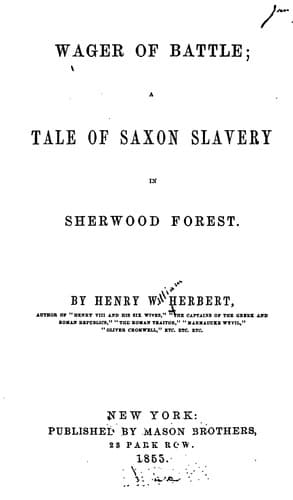
Wager of Battle: A Tale of Saxon Slavery in Sherwood ForestHerbert, Henry William
History
Wager of Battle: A Tale of Saxon Slavery in Sherwood Forest
Herbert, Henry William
Anglo-Saxons -- Fiction; Great Britain -- History -- Norman period, 1066-1154 -- Fiction; Sherwood Forest (England) -- Fiction
In truth, he felt himself indignant and wounded at the unreasonable
perduracy of the man, in refusing an inestimable boon, for what he
chose to consider a cause so trivial; and this, too, though had he
himself been in the donjon of the infidel, expecting momentary death
by the faggot or the rack, and been offered liberty, life, empire,
immortality, on condition of leaving the least-valued Christian woman
to the harem of the Mussulman, he would have spurned the offer with
his most arrogant defiance.
This seemed to him much as it would seem to the butcher, if the bull,
with the knife at his throat, were to speak up and refuse to live,
unless his favorite heifer might be allowed to share his fortunes. It
appeared to him wondrous, indeed, but wondrously annoying, and almost
absurd. In no respect did it strike him as one of the noblest and most
generous deeds of self-abandonment of which the human soul is capable;
though, had the self-same offer been spurned, as the slave spurned it,
and in the very words which he had found in the rude eloquence of
indignation, by belted knight or crowned king, he had unhesitatingly
styled it an action of the highest glory, and worthy of immortal
record in herald's tale or minstrel's story. Such is the weight of
circumstance upon the noblest minds of men.
With his brow bent, and his arms folded on his breast, moodily, almost
sorrowfully, did the good knight of Taillebois wend his way back
toward the towers of Waltheofstow, making no effort to overtake his
brother-in-arms and entertainer, whom he could clearly see stalking
along before him, in no more placable mood than himself, but burying
himself on his return in his own chamber, whence he made his
appearance no more that evening; though he might hear Sir Philip
storming through the castle, till the vaulted halls and passages
resounded from barbican to battlement.
Meantime, in the lowly cottage of the serf--for the lord, though angry
and indignant, had not failed of his plighted word--the lykewake of
the dead boy went on--for that was a Saxon no less than a Celtic
custom, though celebrated by the former with a sort of stolid decorum,
as different as night is from day from the loud and barbarous orgies
of their wilder neighbors.
Public-domain text, read in full here on John Shaqi.
Reviews
Reviews
No reviews yet
Be the first to share your thoughts on this work.
Join the Discussion
Join the discussion
Sign in to leave a comment or review.
Sign InorCreate an account