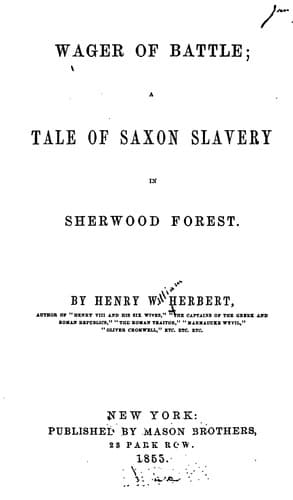
Wager of Battle: A Tale of Saxon Slavery in Sherwood ForestHerbert, Henry William
History
Wager of Battle: A Tale of Saxon Slavery in Sherwood Forest
Herbert, Henry William
Anglo-Saxons -- Fiction; Great Britain -- History -- Norman period, 1066-1154 -- Fiction; Sherwood Forest (England) -- Fiction
She had heard enough, as she entered the house at that decisive
moment, to comprehend the whole; and, if the proud and high-born
knights were at a loss to understand, much less appreciate, the noble
virtue of the serf, the poor uneducated slave girl had seen and felt
it all--felt it thrill to her heart's core, and inspire her weakness
with equal strength, equal devotion.
She had argued, she had prayed, she had implored, clinging to his
knees, that for the love of Heaven, for the love of herself, he would
accept the boon of freedom, and leave her to her fate, which would be
sweeter far to her, she swore, from the knowledge of his prosperity,
than it could be rendered by the fruition of the greatest worldly
bliss. And then, when she found prayer and supplication fruitless,
she, too, waxed strong and glorious. She lifted her hand to heaven,
and swore before the blessed Virgin and her ever-living Son, that,
would he yield to her entreaties and be free, she would be true to
him, and to him alone, forever; but should he still persist in his
wicked and mad refusal of God's own most especial gift of freedom, she
would at least deprive him of the purpose of his impious resolution,
place an impenetrable barrier between them two, and profess herself
the bride of Heaven.
At length, as he only chafed and resisted more and more, till
resistance and fever were working almost delirium--any thing but
conviction and repentance--like a true woman, she betook herself from
argument, and tears, and supplication, to comforting, consoling, and
caressing; and, had the rage and fever of his body, or the terrible
excitement of his tortured mind, been less powerful, she could not but
have won the day, in the noblest of all strifes--the strife of mutual
disinterestedness and devotion.
"O woman! in our hours of ease,
Inconstant, coy, and hard to please;
When pain and anguish rend the brow,
A ministering angel thou!"
CHAPTER VIII.
GUENDOLEN'S BOWER.
"Four gray walls, and four square towers,
Overlook a space of flowers,
And the silent isle imbowers,
The Lady of Shalott."
TENNYSON.
High up in the gray square tower, which constituted the keep of the
castle of Waltheofstow, there was a suite of apartments, the remains
of which are discoverable to this day, known as the Lady's Bower;
which had, it is probable, from the construction of the edifice, been
set apart, not only as the private chambers of the chatelaine and
ladies of the family, her casual guests and their attendants, but as
what we should now call the drawing-rooms, wherein the more social
hours of those rude days were passed, when the sexes intermingled,
whether for the enjoyment of domestic leisure, or for gayety and
pleasure.
Public-domain text, read in full here on John Shaqi.
Reviews
Reviews
No reviews yet
Be the first to share your thoughts on this work.
Join the Discussion
Join the discussion
Sign in to leave a comment or review.
Sign InorCreate an account