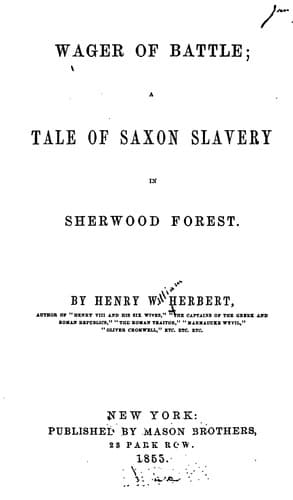
Wager of Battle: A Tale of Saxon Slavery in Sherwood ForestHerbert, Henry William
History
Wager of Battle: A Tale of Saxon Slavery in Sherwood Forest
Herbert, Henry William
Anglo-Saxons -- Fiction; Great Britain -- History -- Norman period, 1066-1154 -- Fiction; Sherwood Forest (England) -- Fiction
The consecrated tapers blazed around the swathed and shrouded corpse,
and sent long streams of light through the open door and lattices of
the humble dwelling, as though it had been illuminated for a high
rejoicing. The death hymn was chanted, and the masses sung by the gray
brothers from the near Saxon cloister. The dole to the poor had been
given, largely, out of the lord's abundance; and the voices of the
rioting slaves, emancipated from all servitude and sorrow, for the
nonce, by the humming ale and strong metheglin, were loud in praises
of their bounteous master, until, drenched and stupefied with liquor,
and drunk with maudlin sorrow, they staggered off to their respective
dens, to snore away the fumes of their unusual debauch, until aroused
at dawn by the harsh cry of the task-master.
By degrees the quiet of the calm summer night sank down over the
dwelling and garden of Kenric, as guest after guest departed, until no
one remained save one old Saxon brother, who sat by the simple coffin,
telling his beads in silence, or muttering masses for the soul of the
dead, apparently unconscious of any thing passing around him.
The aged woman had been removed, half by persuasion, half by gentle
force, from the dwelling-room, and had soon sunk into the heavy and
lethargic slumber which oftentimes succeeds to overwhelming sorrow.
The peaceful moonlight streamed in through the open door of the
cheerless home, like the grace of heaven into a disturbed and sinful
heart, as one by one the tapers flickered in their sockets and
expired. The shrill cry of the cricket, and the peculiar jarring note
of the night-hawk, replaced the droning of the monkish chants, and the
suppressed tumult of vulgar revelry; but, though there was solitude
and silence without, there was neither peace nor heart-repose within.
Sorely shaken, and cruelly gored by the stag in trunk and limbs, and
yet more sorely shaken in his mind by the agitation and excitement of
the angry scene with his master, and by the internal conflict of
natural selfishness with strong conscientious will, Kenric lay, with
his eyes wide open, gazing on his dead nephew, although his mind was
far away, with his head throbbing, and his every nerve jerking and
tense with the hot fever.
But by his side, soothing his restless hand with her caressing touch,
bathing his burning temples with cold lotions, holding the soft
medicaments to his parched lips, beguiling his wild, wandering
thoughts with gentle lover's chidings, and whispering of better days
to come, sat the fair slave girl, Edith, his promised wife, for whose
dear sake he had cast liberty to the four winds, and braved the deadly
terrors of the unforgiving Norman frown.
Public-domain text, read in full here on John Shaqi.
Reviews
Reviews
No reviews yet
Be the first to share your thoughts on this work.
Join the Discussion
Join the discussion
Sign in to leave a comment or review.
Sign InorCreate an account