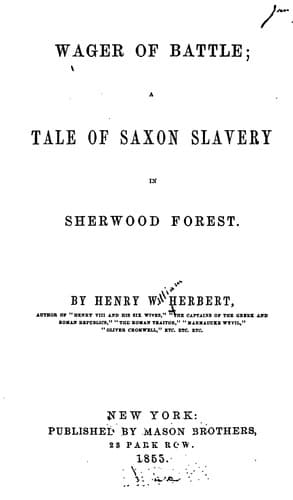
Wager of Battle: A Tale of Saxon Slavery in Sherwood ForestHerbert, Henry William
History
Wager of Battle: A Tale of Saxon Slavery in Sherwood Forest
Herbert, Henry William
Anglo-Saxons -- Fiction; Great Britain -- History -- Norman period, 1066-1154 -- Fiction; Sherwood Forest (England) -- Fiction
Through the thick-vaulted roofs of stone, which rendered every story
of the keep a separate fortress, no sound of arms, of revelry or riot,
could ascend to the region of the ladies; and if their comforts were
inferior to those of our modern beauties, their magnificence, their
splendor of costume, of equipage, of followings, their power at home,
and their influence abroad, where they shone as "Queens of Love and
Beauty," were held the arbiters of fame and dispensers of honor, where
their smiles were held sufficient guerdon for all wildest feats of
bravery, their tears expiable by blood only, their importance in the
outer world of arms, of romance, of empire, were at the least as far
superior; and it may be doubted, whether some, even the most spoiled
of our modern fair ones, would not sigh to exchange, with the dames
and demoiselles of the twelfth century, their own soft empire of the
ball-room for the right to hold Courts of Love, as absolute
unquestioned sovereigns, to preside at tilt and tournament, and send
the noblest and the most superb of champions into mortal combat, or
yet more desperate adventure, by the mere promise of a sleeve, a
kerchief, or a glove.
She, however, who now occupied alone the Lady's Bower of Waltheofstow
was none of your proud and court-hardened ladies, who could look with
no emotion beyond a blush of gratified vanity on the blood of an
admirer or a lover. Though for her, young as she was, steeds had been
spurred to the shock, and her name shouted among the splintering of
lances and the crash of mortal conflict, she was still but a simple,
amiable, and joyous child, who knew more of the pleasant fields and
waving woodlands of her fair lake-country, than of the tilt-yard, the
court pageant, or the carousal, and who better loved to see the
heather-blossom and the blue-bell dance in the free air of the breezy
fells, than plumes and banners flaunt and flutter to the blare of
trumpets.
The only child of Sir Yvo de Taillebois, a knight and noble of the
unmixed Norman blood, a lineal descendant of one of those hardy barons
who, landing with Duke William on his almost desperate emprise, had
won "the bloody hand" at Hastings, and gained rich lands in the
northern counties during the protracted struggle which ensued, the
Lady Guendolen had early lost her mother, a daughter of the noble
house of Morville, and not a very distant relative of the good knight,
Sir Philip, whose hospitality she was now partaking with her father.
Public-domain text, read in full here on John Shaqi.
Reviews
Reviews
No reviews yet
Be the first to share your thoughts on this work.
Elsewhere in the archive
Join the Discussion
Join the discussion
Sign in to leave a comment or review.
Sign InorCreate an account