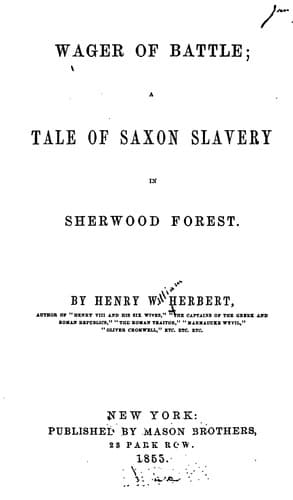
Wager of Battle: A Tale of Saxon Slavery in Sherwood ForestHerbert, Henry William
History
Wager of Battle: A Tale of Saxon Slavery in Sherwood Forest
Herbert, Henry William
Anglo-Saxons -- Fiction; Great Britain -- History -- Norman period, 1066-1154 -- Fiction; Sherwood Forest (England) -- Fiction
To a girl, for the most part, the loss of a mother, before she has
reached the years of discretion, is one never to be repaired, more
especially where the surviving parent is so much occupied with duties,
martial or civil, as to render his supervision of her bringing-up
impossible. It is true that, in the age of which I write, the
accomplishments possessed by the most delicate and refined of ladies
were few and slight, as compared to those now so sedulously inculcated
to our maidens, so regularly abandoned by our matrons; and that, at a
period later by several centuries, he who has been styled, by an
elegant writer,[3] the last of the Norman barons, great Warwick the
Kingmaker, held it a boast that his daughters possessed no arts, no
knowledge, more than to spin and to be chaste.
[3] Sir E. Lytton Bulwer.
Yet even this small list of feminine attainments was far beyond the
teaching of the illiterate and warlike barons, who knew nought of the
pen, save when it winged the gray-goose shaft from the trusty yew, and
whose appropriate and ordinary signatures were the impress of their
sword-hilts on the parchments, which they did not so much as pretend
to read; and, in truth, the Kingmaker's statement must either be
regarded as an exaggeration, or the standard of female accomplishment
had degenerated, as is not unlikely to have been actually the case,
during the cruel and devastating wars of the Roses, which, how little
soever they may have affected the moral, political, or agricultural
condition of the English people at large, had unquestionably dealt a
blow to the refinement, the courtesy, the mental culture, and personal
polish of the English aristocracy, from which they began only to
recover in the reigns of the later Tudors.
But in the case of the fair Guendolen, neither did the loss of her
mother deprive her of the advantages of her birth, nor would the
incapacity of her father, had the occasion been allowed him of
superintending the culture of his child, have done so; for he was--at
that day rarer in England than was a wolf, though literary culture had
received some impulse from the present monarch, and his yet more
accomplished father, Beauclerc--a man of intellectual ability, and not
a little cultivation.
Public-domain text, read in full here on John Shaqi.
Reviews
Reviews
No reviews yet
Be the first to share your thoughts on this work.
Elsewhere in the archive
Join the Discussion
Join the discussion
Sign in to leave a comment or review.
Sign InorCreate an account