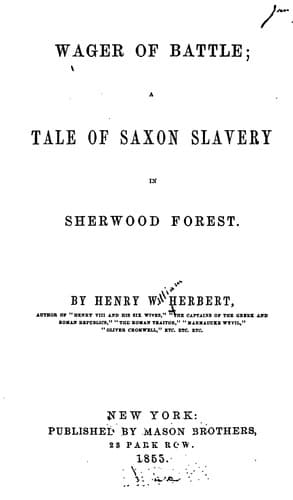
Wager of Battle: A Tale of Saxon Slavery in Sherwood ForestHerbert, Henry William
History
Wager of Battle: A Tale of Saxon Slavery in Sherwood Forest
Herbert, Henry William
Anglo-Saxons -- Fiction; Great Britain -- History -- Norman period, 1066-1154 -- Fiction; Sherwood Forest (England) -- Fiction
He had been a pilgrim, a prisoner in the Holy Land, had visited the
wild monasteries of Lebanon and Athos; he had seen the pyramids
"piercing the deep Egyptian sky," had mused under the broken arches of
the Coliseum, and listened, like the great historian of Rome, to the
bare-footed friars chanting their hymns among the ruins of Jupiter
Capitoline.
Like Ulysses, he had seen the lands, he had studied the manners, and
learned to speak the tongues, of many men and nations; nor, while he
had learned in the east strange mysteries of science, though he had
solved the secrets of chemistry, and learned, long before the birth of
"starry Galileo," to know the stars with their uprisings and their
settings; though he knew the nature, the properties, the secret
virtues, and the name of every floweret of the forest, of every ore of
the swart mine, he had not neglected the gentler culture, which
wreathes so graciously the wrinkled brow of wisdom. Not a poet
himself, so far as the weaving the mysterious chains of rhythm, he was
a genuine poet of the heart. Not a blush, not a smile, not a tear, not
a frown on the lovely face of nature, but awakened a response in his
large and sympathetic soul; not an emotion of the human heart, from
the best to the basest, but struck within him some chord of deep and
hidden feeling; to read an act of self-devoted courage, of charity, of
generosity, of self-denial, would make his flesh quiver, his hair
rise, his cheek burn. To hear of great deeds would stir him as with
the blast of a war trumpet. He was one, in fact, of those gifted
beings who could discern
"Music in running brooks,
Sermons in stones, and good in every thing;"
and as he felt himself, so had he taught her to feel; and of what he
knew himself, much he had taught her to know likewise.
Seeing, hearing, knowing him to be what he was, and, as is the wont
ever with young and ingenuous minds, imagining him to be something far
wiser, greater, and better than he really was, she was content at
first, while other men were yet unknown to her, to hold him something
almost supernaturally, ineffably beneficent and wise; and this
incomparable being she knew also to be a Saxon. She saw her aunt, who,
gentle as she was, and gracious, had yet a touch of the old Norse
pride of blood, untutored by the teachings of religion, and untamed by
the discipline of the church, bow submissively to his advice, defer
respectfully to his opinion, hang persuaded on his eloquence--and yet
he was a Saxon.
Public-domain text, read in full here on John Shaqi.
Reviews
Reviews
No reviews yet
Be the first to share your thoughts on this work.
Elsewhere in the archive
Join the Discussion
Join the discussion
Sign in to leave a comment or review.
Sign InorCreate an account