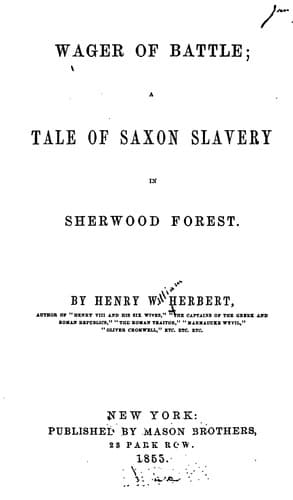
Wager of Battle: A Tale of Saxon Slavery in Sherwood ForestHerbert, Henry William
History
Wager of Battle: A Tale of Saxon Slavery in Sherwood Forest
Herbert, Henry William
Anglo-Saxons -- Fiction; Great Britain -- History -- Norman period, 1066-1154 -- Fiction; Sherwood Forest (England) -- Fiction
The abbey lands were ever the best tilled; the abbey tenants ever the
happiest, the best clad, the richest, and the freest of the peasantry
of England. The monks, those of Saxon race especially, were the
country curates of the twelfth century; it was they who fed the
hungry, who medicined the sick, who consoled the sad at heart, who
supported the widow and the fatherless, who supported the oppressed,
and smoothed the passage through the dark portals to the dying
Christian. There were no poor laws in those days, nor alms-houses; the
open gates and liberal doles of the old English abbeys bestowed
unstinted and ungrudging charity on all who claimed it. The abbot on
his soft-paced palfrey, or the prioress on her well-trained jennet, as
they made their progresses through the green fields and humble hamlets
of their dependents, were hailed ever with deferential joy and
affectionate reverence; and the serf, who would lout sullenly before
the haughty brow of his military chief, and scowl savagely with hand
on the dudgeon hilt after he had ridden past, would run a mile to
remove a fallen trunk from the path of the jolly prior, or three, to
guide the jennet of the mild-eyed lady abbess through the difficult
ford, or over the bad bit of the road, and think himself richly paid
by a benediction.
In such a tranquil tenor had been passed the early years of the
beautiful young Guendolen; and while she learned every accomplishment
of the day--for in those days the nunneries were the schools of all
that was delicate, and refined, and gentle, the schools of the softer
arts, especially of music and illumination, as were the monasteries
the shrines which alone kept alive the fire of science, and nursed the
lamp of letters, undying through those dark and dreary ages--she
learned also to be humble-minded, no less than holy-hearted, to be
compassionate, and kind, and sentient of others' sorrows; she learned,
above all things, that meekness and modesty, and a gentle bearing
toward the lowliest of her fellow-beings, were the choicest ornaments
to a maiden of the loftiest birth.
Herself a Norman of the purest Norman strain, descended from those of
whom, if not kings themselves, kings were descended, who claimed to be
the peers of the monarchs to whom their own good swords gave royalty,
she had never imbibed one idea of scorn for the conquered, the
debased, the downfallen Saxon.
The kindest, the gentlest, the sagest, and at the same time the most
refined and polished of all her preceptors, her spiritual pastor also,
and confessor, was an old Saxon monk, originally from the convent of
Burton on the Trent, who had migrated northward, and pitched the tent
of his declining years in a hermitage situate in the glade of a deep
Northumbrian wood, not far removed from the priory over which her aunt
presided with so much dignity and grace.
Public-domain text, read in full here on John Shaqi.
Reviews
Reviews
No reviews yet
Be the first to share your thoughts on this work.
Elsewhere in the archive
Join the Discussion
Join the discussion
Sign in to leave a comment or review.
Sign InorCreate an account