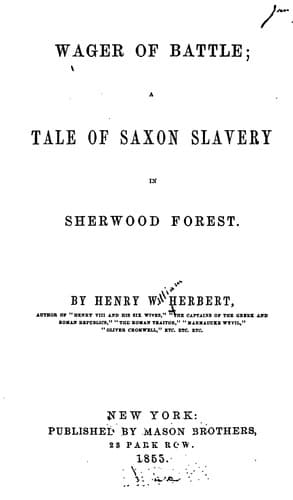
Wager of Battle: A Tale of Saxon Slavery in Sherwood ForestHerbert, Henry William
History
Wager of Battle: A Tale of Saxon Slavery in Sherwood Forest
Herbert, Henry William
Anglo-Saxons -- Fiction; Great Britain -- History -- Norman period, 1066-1154 -- Fiction; Sherwood Forest (England) -- Fiction
"Very weak, Edith, and sore all over. I feel as if every limb were
broken; and I want you, with your gentle hand and gentle voice, to
soothe me."
"Ah! dearest lady, our Holy Mother send that your spirit never may be
so sore as to take no heed of the body's aching, nor your heart so
broken as to know not whether your limbs were torn asunder."
CHAPTER X.
THE LADY AND THE SLAVE.
"Weep not for him that dieth,
For his struggling soul is free,
And the world from which it flieth
Is a world of misery;
But weep for him that weareth
The collar and the chain;
To the agony he beareth,
Death were but little pain."
CAROLINE NORTON.
"What mean you, Edith?" inquired the girl, raising herself from her
pillow, as her attention was called to the unusually subdued tones of
the Saxon maiden, who was, in her ordinary mood, so gay and joyous,
and who appeared to be the general favorite of all around her; "what
mean you, Edith?" she repeated; "you can not be speaking of yourself;
you, who are ever blithesome and light-hearted as the bee on the
blossom, or the bird on the bough. You can have no sorrows of the
heart, I think, so penetrating as to make all outward bodily pains
forgotten, and yet--you are pale, you are weeping? Tell me, girl--tell
me, dear Edith, and let me be your friend."
"Friend! lady," said the girl, looking at her wistfully, yet
doubtfully withal; "you _my_ friend, noble lady! That were indeed
impossible. I will not say, that to the poor, to the Saxon, to the
_slave_, there can be _no_ friend, under heaven; but that you--you,
a noble and a Norman! Alas! alas! that were indeed impossible!"
"Impossible!" cried Guendolen, eagerly, forgetting her ailments in her
fine and feeling excitement. "Wherefore, how should it be impossible?
One God made us both, Edith; and made us both out of one clay, with
one life here on earth, and one hereafter; both children of one fallen
race, and heirs of one promise; both daughters of one fair, free land;
both Englishwomen--then why not friends, Edith, and sisters?"
Public-domain text, read in full here on John Shaqi.
Reviews
Reviews
No reviews yet
Be the first to share your thoughts on this work.
Elsewhere in the archive
Join the Discussion
Join the discussion
Sign in to leave a comment or review.
Sign InorCreate an account