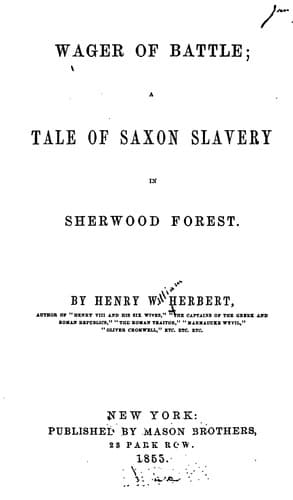
Wager of Battle: A Tale of Saxon Slavery in Sherwood ForestHerbert, Henry William
History
Wager of Battle: A Tale of Saxon Slavery in Sherwood Forest
Herbert, Henry William
Anglo-Saxons -- Fiction; Great Britain -- History -- Norman period, 1066-1154 -- Fiction; Sherwood Forest (England) -- Fiction
"Of one land, lady, it is true," said the girl, gently. "Yes!
daughters of one _fair_ land, for even to the slave England is
very beautiful and dear, even as to you she is _free_. But for
us, who were once her first-born and her favorites, that magic word
has passed away, that charm has ceased, forever. For us, in free
England's wide-rejoicing acres, there is no spot free, save the six
feet of earth that shall receive our bodies, when the soul shall be a
slave's no longer. Lady, lady, alas! noble lady, if one God made us
both of one clay, that shall go downward to mingle with the common
sod, and of one spirit that shall mount upward, when the weariness and
woe shall be at an end forever, man has set a great gulf between us,
that we can not pass over it at all, to come the one unto the other.
Our wants may be the same, while we are here below, and our hopes may
be the same heavenward; but there all sameness ends between us. My
joys can not be your joys, and God forbid that my sorrows should be
yours, either. Our hearts may not feel, our heads may not think, in
unison, even if our flesh be of one texture, and our souls of one
spirit. You are good, and gentle, and kind, lady, but you may never
understand what it is to be such as I."
She ceased, but she ceased weeping also, and seemed lost in deep
thought, and almost forgetful of herself and her surroundings, as she
remained on her knees by the bedside of Guendolen, with her head
drooping from her fair bended neck, and her embrowned but shapely
hands folded in her lap.
The lady looked at her silently for a few moments, partly in sympathy,
partly, it must be said, in wonder. New ideas were beginning to be
awakened in her mind, and a perception of something, which had never
before dawned upon her, became palpable and strong.
That which we behold, and have beheld daily perhaps for years,
naturally becomes so usual and customary in our eyes, that we cease to
regard it as any thing but as a fact, of which we have never seen and
scarcely can conceive any thing to the contrary--that we look at it as
a part of that system which we call nature, and of which we never
question the right or the wrong, the injustice or the justice, but,
knowing that it _is_, never think of inquiring wherefore it is,
and whether it ought to be.
Thus it was with Guendolen de Taillebois. She had been accustomed,
during all her life, to see Saxons as serfs, and rarely in any other
capacity; for the franklins and thanes who had retained their
independence, their freedom, and a portion of their ancestral acres,
were few in numbers, and held but little intercourse with their Norman
neighbors, being regarded by them as rude and semi-barbarous
inferiors, while they, in turn, regarded them as cruel and insolent
usurpers and oppressors.
Public-domain text, read in full here on John Shaqi.
Reviews
Reviews
No reviews yet
Be the first to share your thoughts on this work.
Elsewhere in the archive
Join the Discussion
Join the discussion
Sign in to leave a comment or review.
Sign InorCreate an account