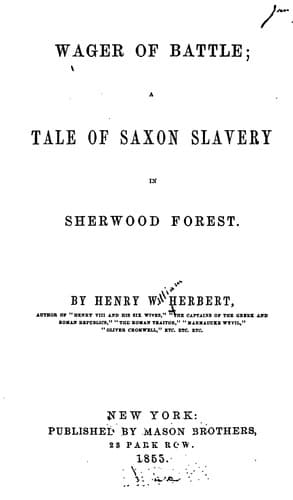
Wager of Battle: A Tale of Saxon Slavery in Sherwood ForestHerbert, Henry William
History
Wager of Battle: A Tale of Saxon Slavery in Sherwood Forest
Herbert, Henry William
Anglo-Saxons -- Fiction; Great Britain -- History -- Norman period, 1066-1154 -- Fiction; Sherwood Forest (England) -- Fiction
"And yet, you were both gay and joyous yesterday, Edith; and all last
week, since I have been at the castle, I have heard no sounds so gay
or so pleasant to my ear as your merry ballads. And you are no more a
serf this morn than you were yestrene, and the good God alone knows
what any of us all may be on the morrow, Edith. Something, I know,
must have happened, girl, to make you wear a face so altered on this
beautiful summer day, and carry so sad a heart, when all the world is
so happy."
"All the world, lady!" replied Edith; "all the world happy! Alas! not
one tenth of it, unless you mean the beasts and the birds, which,
knowing nothing, are blithe in their happy innocence. Of the human
world around us, lady, one half knows not, and more by far than one
half cares not, how miserable or how hopeless are their fellows--nor,
if all knew and cared for all, could they either comprehend or
console, much less relieve, the miserable."
"But if I be one of those, Edith, who know not, I am at least not one
of those who care not. Therefore, I come back to the place whence I
started. Something has happened, which makes you dwell so much more
dolefully to-day, upon that which weighed not on you, yestrene,
heavier than a feather."
"Something _has_ happened, lady. But it is all one; for it resolves
itself in all but into this; I am a slave--a slave, until life is
over."
"This is strange," said Guendolen, thoughtfully. "I do not
understand--_may_ not understand this. It does not seem to me
that your duties are so very hard, your life so very painful, or your
rule so very strict, that you should suddenly thus give way to utter
gloom and despondency, for no cause but what you have known for years,
and found endurable until this moment."
"But henceforth unendurable. Oh! talk not, lady, talk not. You may
console the dying, for to him there is a hope, a present hope of a
quick-coming future. But comfort not the slave; for to him the
bitterest and most cruel past is happier than the hopeless present, if
only for that it is past; and the present, hopeless as it is, is yet
less desperate than the future; for to the slave, in the future, every
thing except happiness is possible. I may seem to speak enigmas to
you, lady, and I am sure that you do not understand me--how should
you? None but a slave can know or imagine what it is to be a slave;
none can conceive what a slave feels, thinks, suffers. And yet a slave
is a man, after all; and a lord is no more than a man, while
living--and yet, what a gulf between them!"
"And you will not tell me, Edith," persisted the Lady Guendolen, "you
will not tell me what it is that has happened to you of late, which
makes you grieve so despondently, thus on a sudden, over your
late-endured condition? Then you must let me divine it. You have
learned your own heart of late. You have discovered that you love,
Edith."
Public-domain text, read in full here on John Shaqi.
Reviews
Reviews
No reviews yet
Be the first to share your thoughts on this work.
Elsewhere in the archive
Join the Discussion
Join the discussion
Sign in to leave a comment or review.
Sign InorCreate an account