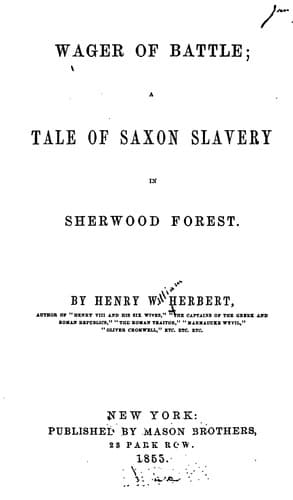
Wager of Battle: A Tale of Saxon Slavery in Sherwood ForestHerbert, Henry William
History
Wager of Battle: A Tale of Saxon Slavery in Sherwood Forest
Herbert, Henry William
Anglo-Saxons -- Fiction; Great Britain -- History -- Norman period, 1066-1154 -- Fiction; Sherwood Forest (England) -- Fiction
The value, in the first place, of the unhappy beings, to each of whom,
as to a beast of burden, or to a piece of furniture, a regular
money-price was attached, although they could not be sold away from
the land to which they appertained, unless by their own consent, was
by no means inconsiderable even to one so rich as Sir Yvo de
Taillebois; for in those days the wealth even of the greatest landed
proprietors lay rather in the sources of revenue, than in revenue
itself; and men, whose estates extended over many parishes, exceeding
far the limits of a modern German principality, whose forests
contained herds of deer to be numbered by the thousand head, whose
cattle pastured over leagues of hill and valley, who could raise
armies, at the lifting of their banners, larger than many a sovereign
prince of the nineteenth century, were often hard set to find the
smallest sums of ready money on emergency, unless by levying tax or
scutage on their vassals, or by applying to the Jews and Lombards.
In the second place, the scruples of Kenric, which justly appeared so
generous and noble to the fine, unsophisticated intellect of the young
girl, by no means appeared in the same light to the proud barons,
accustomed to regard the Saxon, and more especially the serf, as a
being so palpably and manifestly inferior, that he was scarcely deemed
to possess rights, much less sentiments or feelings, other than those
of the lower animals.
To them, therefore, the Saxon's refusal to consent to his own sale as
a step necessary to manumission, appeared an act of insolent
outrecuidance, or at the best a bold and impudent piece of chicanery,
whereby to extort from his generous patrons a recompense three times
greater than they had thought of conferring on him, in the first
instance.
It was with scorn, therefore, and almost with anger, that Sir Yvo
listened to the first solicitations of Guendolen in behalf of her
clients; and he laughed at her high-flown sentiments of admiration and
wonder at the self-devotion, the generosity, the immovable constancy,
of the noble Saxon.
"The _noble_ Saxon! By the glory of Heaven!" he exclaimed, "these
women would talk one out of all sense of reason, with their
sympathetic jargon! Why, here's a sturdy knave, who has done what, to
win all this mighty gratitude? Just stuck his whittle into a wild
stag's weasard, and saved a lady's life, more by good luck than by
good service--as any man, or boy, of Norman blood, would have done in
a trice, and thought no more of it; and then, when his freedom's
tendered him as a reward for doing that for which ten-pence had well
paid him, and for failing to do which he had deserved to be scourged
till his bones lay bare, he is too mighty to accept it--marry! he
names conditions, he makes terms, on which he will consent to oblige
his lords by becoming free; and you--you plead for him. The _noble_
Saxon! by the great gods, I marvel at you, Guendolen."
Public-domain text, read in full here on John Shaqi.
Reviews
Reviews
No reviews yet
Be the first to share your thoughts on this work.
Elsewhere in the archive
Join the Discussion
Join the discussion
Sign in to leave a comment or review.
Sign InorCreate an account