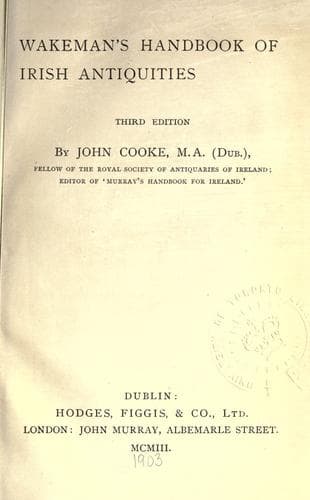
Wakeman's handbook of Irish antiquitiesWakeman, W. F. (William Frederick)
History
Wakeman's handbook of Irish antiquities
Wakeman, W. F. (William Frederick)
Ireland -- Antiquities
The chipped implements are of flint and very rude, thick, and heavy
towards the edge, with a blunt point. They resemble the Palæolithic
type, and are found in the raised beaches of Larne, and are known
as the ‘Larne Implements.’ Of an equally rude kind are those found
in hut-sites round the coast, in the Bann Valley, and elsewhere.
Implements of a similar type are found in the shell-mounds of Denmark,
in Scandinavia, and other parts of Europe. They are named the
‘kitchen-midden’ type, and are considered to be the earliest worked by
Neolithic man.
Of the second class many are of flint: the lower part is polished down,
giving a fine cutting edge, and the upper portion is left with a rough
flaked surface. Many of the larger implements belong to this class, and
were the more readily fastened into the haft. These and the polished
celts are made of basalt, porphyry, felstone, greenstone, shale, and
other rocks; the felstone was much sought for, on account of the fine
cutting edge that could be obtained in sharpening. They vary greatly
in size, the average being 6 to 8 inches in length, and in breadth 2 to
3½ inches. The largest yet found is in the National Museum: it is of
clay slate and about 22 inches long. They vary greatly, too, in shape,
and are ovate--that is, of a somewhat egg-shaped form--or triangular,
according to the general cast of the sides and edge.
[Illustration: Polished Celt of Felstone--scale two-thirds.]
[Illustration: Various Types of Stone Celts--scale one-eighth.]
[Illustration: Mounted Celt.]
Public-domain text, read in full here on John Shaqi.
Reviews
Reviews
No reviews yet
Be the first to share your thoughts on this work.
Elsewhere in the archive
Join the Discussion
Join the discussion
Sign in to leave a comment or review.
Sign InorCreate an account