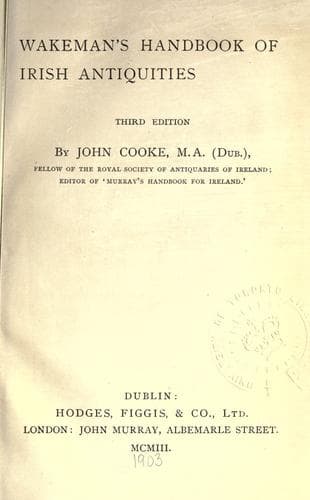
Wakeman's handbook of Irish antiquitiesWakeman, W. F. (William Frederick)
History
Wakeman's handbook of Irish antiquities
Wakeman, W. F. (William Frederick)
Ireland -- Antiquities
Arrow-heads of copper or bronze are rare; the metals were too valuable
to be used in any general sense in such weapons. Javelin-heads,
generally differing from the spears in size only, have been found in
our principal crannogs; but no trace of a bow, so far as we are aware,
has been recognized amongst the numerous relics formed of wood which
usually accompany the metallic remains. Many of the smaller heads in
the National Museum were probably used as bolts for cross-bow purposes.
* * * * *
[Illustration: Bronze Shield from Lough Gur.]
_Shields._--There can be little doubt that the lake-dwellers in
Ireland--such of them at least as were able to bear arms--were in the
possession of shields, some of which were formed of bronze. Not far
from Lough Gur--a sheet of water with crannogs--in the County Limerick,
a very fine shield composed of bronze was accidentally brought to
light. This occurred during drainage operations some fifty years ago,
when a large number of bronze arms and implements were discovered.
This is known as the ‘Lenihan’ shield; it is circular in plan, the
diameter being 28 inches, and slightly convex; the centre rises about
1¼ inches above the rim; and the _umbo_, which is 6 inches wide at the
base, rises in conical form 1¾ inches above the shield. ‘The hollow of
the _umbo_ internally is crossed by a stout handle, firmly riveted to
the shield, of sheet bronze bent into a round. The metal of the shield
is formed at the edge into a round hollow rim by being most skilfully
turned inwards into a roll ¼ inch wide; between it and the _umbo_ are
six beaten-up circular ribs, and six rows of small studs. In the circle
next the rim there are seventy-three studs, and in that next the _umbo_
twenty-two. The bronze, which is of a fine golden colour, is about the
thickness of a worn shilling next the rim, and of a sixpence near the
centre.’ The metal is much too thin to have been of any service by
itself, so that it probably was the outer and ornamental covering of
a ‘tough bull-hide.’ Plates of this kind, examples of which have been
found in Great Britain, seem to belong to the close of the Bronze Age.
Sculptured upon one of the crosses at Kells, Co. Meath, are armoured
figures with round shields, showing that these defences were used in
the early Christian period at least.
Many pieces of hammered sheet-iron, which appear to have belonged to
shields, have from time to time been found in crannogs. It is probable,
however, that shields were, as a general rule, formed of wicker-work,
or wood, covered with a piece of animal hide. It was not until man, as
Sir John Evans points out, had made considerable advance in the use of
bronze that he could have prepared plates, like that of the Lough Gur
type, wherewith to cover a shield.
* * * * *
Public-domain text, read in full here on John Shaqi.
Reviews
Reviews
No reviews yet
Be the first to share your thoughts on this work.
Elsewhere in the archive
Join the Discussion
Join the discussion
Sign in to leave a comment or review.
Sign InorCreate an account