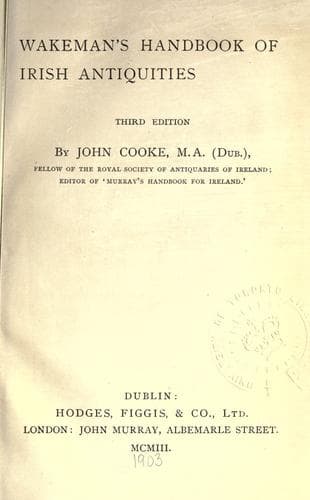
Wakeman's handbook of Irish antiquitiesWakeman, W. F. (William Frederick)
History
Wakeman's handbook of Irish antiquities
Wakeman, W. F. (William Frederick)
Ireland -- Antiquities
‘To understand,’ says Sir William Wilde, ‘or appreciate the nature of
these dwellings, we must bring back our minds to the period when the
country around the localities where they occur was covered with wood,
chiefly oak and alder, and when the state of society had passed from
that of the simple shepherd or pastoral condition, to one of rapine,
plunder, and invasion. Certain communities, families, or chieftains
required greater security for themselves, their cattle, or their
valuables than the land could afford, and so betook themselves to the
water. With infinite labour, considering the means and appliances at
their disposal, these people cut down young oak-trees, which they
carried to the lakes and drove into the clay or mud around the shallows
of these islands, which were usually, I believe, covered with water
in winter; and having thus formed a stockade which rose above the
water into a breastwork, probably interlaced with saplings, they
floored with alder, sallow, or birch, to a suitable height above the
winter flood, the space so enclosed, and on this platform erected
wooden cabins. One large flag, at least, was also carried in for a
hearthstone, or common cooking-place; and one or more querns, or
hand-mills, have almost invariably been found in the remains of these
crannogs.’
As far back as 1810 a lake-dwelling was discovered at Roscrea, but
no special attention was given to it, as its precise nature was not
understood. In 1839 the curiosity of Wilde and Petrie was aroused by
the very frequent visits of a dealer bringing quantities of antiquarian
objects for sale to the Royal Irish Academy. These, he said, had been
found in the bog of Lagore, near Dunshaughlin, Co. Meath. A visit
was paid to the spot, and a large collection of weapons, articles
of personal and domestic use, objects of bone and wood were seen.
This collection was unfortunately soon scattered, though some of it
was secured for the Academy Museum. The Lagore lake-dwelling stood
at a slight elevation above the surrounding bog, and consisted of a
circular mound 520 feet in circumference. The waters of the lake in
which it stood had been drained many years before, and during some
subsequent operations on the stream, a quantity of bones were found;
numbers of bone-gatherers came and carted off 150 loads, which were
sent to Scotland for the manufacture of manure. The island was formed
by ‘upright posts of black oak, measuring from 6 to 8 feet in height;
these were mortised into beams of a similar material laid flat upon
the marl and sand beneath the bog, and nearly 16 feet below the
present surface. The upright posts were held together by connecting
cross-beams, and (said to be) fastened by large iron nails; parts of
a second upper tier of posts were likewise found resting on the lower
ones.’
Public-domain text, read in full here on John Shaqi.
Reviews
Reviews
No reviews yet
Be the first to share your thoughts on this work.
Elsewhere in the archive
Join the Discussion
Join the discussion
Sign in to leave a comment or review.
Sign InorCreate an account