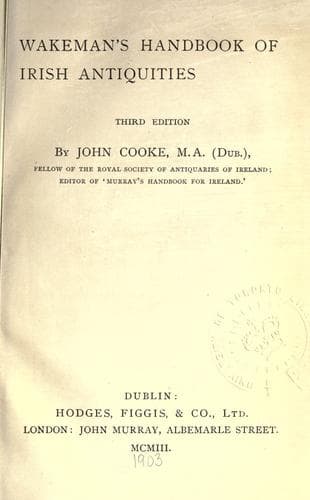
Wakeman's handbook of Irish antiquitiesWakeman, W. F. (William Frederick)
History
Wakeman's handbook of Irish antiquities
Wakeman, W. F. (William Frederick)
Ireland -- Antiquities
By drainage operations, crannogs were laid bare in the Lakes
Ardakillin, Cloonfinlough, and Clonfree, near Strokestown, in 1852.
These proved exceptionally rich in ‘finds,’ consisting of implements
and personal and domestic articles of bones, bronze, and iron. The
surface of Cloonfinlough seemed to have been twice laid. Here a skull
was found; and among the bronze articles was a lamp of Roman type.
One of the four crannogs in Ardakillin yielded 50 tons of bones. The
section of another is here given. ‘Under a slight earthy deposit,
there was a deep layer of loose stones, bounded by an enclosing wall,
the foundation supported by piling. The lower portion of the island
consisted of clay, peat, and stones, mingled with strata of ashes,
bones, and logs of timber. The various rows of oak-piling are shown in
the section; the sheet-piling, driven in obliquely, formed an unbroken
circle round the island.’[113] The ‘finds’ were numerous and varied,
including bone pins and combs, articles of bronze, beads of stone,
glass, and amber. Near the crannog was found a canoe 40 feet long, made
from a single oak trunk; in it were discovered a skull, spear-head,
and bronze pin. The skull showed that it had received twenty cuts with
a sharp weapon, and though no one cut necessarily proved fatal, death
no doubt ensued from the accumulated injuries. Up to the year 1857,
forty-seven lacustrine dwellings had been discovered; and since then
the work of investigation of these sites has been steadily carried
on; and the number now known is over 230. Of these, Ulster has about
one-half, and Connaught one-third. The Lisnacroghera crannog, near
Broughshane, County Antrim, was discovered in 1882; but its features
had been destroyed before a proper examination could be made of the
site. Most of the ‘finds’ fell into the hands of the late Canon
Grainger; many of them were of exceptional value, and will be treated
of in another chapter.
Public-domain text, read in full here on John Shaqi.
Reviews
Reviews
No reviews yet
Be the first to share your thoughts on this work.
Elsewhere in the archive
Join the Discussion
Join the discussion
Sign in to leave a comment or review.
Sign InorCreate an account