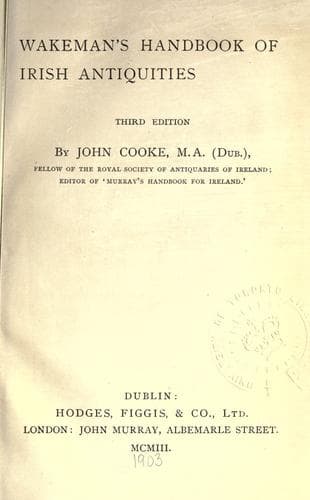
Wakeman's handbook of Irish antiquitiesWakeman, W. F. (William Frederick)
History
Wakeman's handbook of Irish antiquities
Wakeman, W. F. (William Frederick)
Ireland -- Antiquities
Oak paddles, well formed, and measuring about 4 feet in length, often
occur in connexion with the canoes. It is very probable that the
_Currach_ or ‘cot’ formed of basket-work, covered with skin of the cow,
horse, or deer, was in use amongst the lake-dwellers. Owing to the
perishable nature of the materials none of these have been found. That
they were used at an early period in the British Isles is attested by
Roman writers. The primitive willow-ribbed and basket-woven cot, with
water-tight covering, has been used by the fishermen on the Boyne down
to our own day. The canvas-covered skiffs of to-day in Clare, Galway,
the Aran Isles, Mayo, and Donegal are the survivals of a similar type
which have been used by the dwellers on the Atlantic coast from early
times.
CHAPTER X.
ORATORIES: EARLY CHURCHES.
EARLY MONASTIC LIFE--SKELLIG MICHAEL--GALLERUS--KILMALKEDAR--BISHOP’S
ISLAND--HIGH ISLAND--INISMURRAY--DESCRIPTION OF EARLY CHURCHES--
KILLINEY--KILTERNAN--ST. MAC DARA’S CHURCH--GLENDALOUGH AND ITS
CHURCHES--STONE-ROOFED BUILDINGS--FRIAR’S ISLAND--ST. COLUMBA’S
HOUSE, KELLS--ST. FLANNAN’S CHURCH.
It was long considered an established fact that the churches of
Ireland, previous to the twelfth century, were altogether constructed
of wood, or wattles daubed with clay. It was consequently held, on the
authority of Ware, that there remained in the country not a single
example of church architecture of a period much antecedent to A.D.
1148, in which year died Malachy O’Morgair, who is stated to have
erected at Bangor the first ecclesiastical building of stone that had
ever appeared in Ireland. The well-directed labours of George Petrie,
in seeking among the archæological remains themselves for evidence by
which their era might be determined, and in adducing the testimony of
Irish manuscripts relative to such structures as were in use at the
time of their composition, removed the veil of obscurity which had
so long shrouded the subject of Irish ecclesiastical antiquities.
He showed that the country not only contains examples of church
architecture of the earliest period of Christianity in the kingdom, but
also that they exhibit many characteristics of exceptional interest.
Though wood appears to have been the material of which the first
churches were built, where stone was not abundant and otherwise unused,
they were subsequently constructed of stone, and from their small
size and peculiar features are among the most interesting remains now
existing. The buildings called oratories were evidently intended for
the private devotions of the founders, whose graves are so frequently
to be found in their immediate neighbourhood. The most singular of
these are in the west and south-west of Ireland, and they are generally
in sequestered and isolated spots, not only on the small and almost
inaccessible islands off the coast, but on mountain tops and lonely
lake islands.
[Illustration: Clochaun na Carriage, Aran Island.]
Public-domain text, read in full here on John Shaqi.
Reviews
Reviews
No reviews yet
Be the first to share your thoughts on this work.
Elsewhere in the archive
Join the Discussion
Join the discussion
Sign in to leave a comment or review.
Sign InorCreate an account