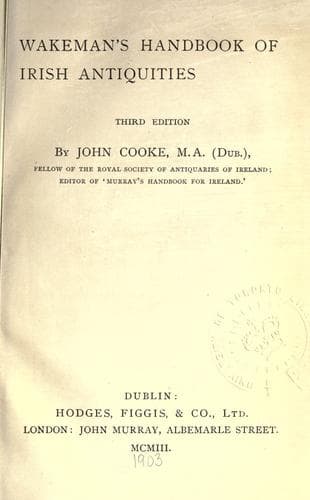
Wakeman's handbook of Irish antiquitiesWakeman, W. F. (William Frederick)
History
Wakeman's handbook of Irish antiquities
Wakeman, W. F. (William Frederick)
Ireland -- Antiquities
_Kilternan Church._--The Church of Kilternan, situated near the little
village of Golden Ball, about six miles from Dublin, on the Enniskerry
road, presents several features of considerable interest. The south
side-wall and the west gable are original, and of great antiquity. The
latter contains a square-headed doorway, now stopped up with masonry;
and to supply its place, a Pointed entrance has been inserted in the
south side-wall. This alteration was made probably at the time of the
re-erection of the east end, the style of which indicates a period not
earlier than the close of the thirteenth century, about which time
the custom of placing the doorway in the west end appears to have
ceased. There are several other churches in the immediate neighbourhood
of Dublin which contain very primitive features; but they have been
altered and remodelled at various times, and are, upon the whole,
characteristic of later periods. Some of these we shall notice when
describing the Early Pointed style, as found in Irish churches.
* * * * *
[Illustration: St. Mac Dara’s Church.]
_The Church of St. Mac Dara._--The almost barren island containing
the church dedicated to this saint lies off the coast of Connemara,
due south of Roundstone Bay. The church is one of the most remarkable
examples of the small stone-roofed churches now remaining. It measures
14 feet 8 inches by 11 feet 3 inches internally; and the walls are 2
feet 8 inches thick; the side-walls project about one foot beyond the
gables, into which they are not bonded. It is lit by a round-headed
and deeply-splayed window in the east wall, and by a rectangular one
in the south wall. It is built of massive masonry, some of the blocks
measuring from 4½ to 5 feet long, and several feet wide. It had a
high-pitched stone roof resting upon the side-walls, portions of
which still remain. The walls of several circular clochauns, now much
defaced, lie north of the church near the shore. The island is still a
great place of pilgrimage, and passing boats have long been accustomed
to lower their sails three times in honour of the saint.
* * * * *
_Glendalough._--In the lone and singularly picturesque valley of
Glendalough (Co. Wicklow), surrounded by high, gloomy mountains,
upon which clouds almost continually rest, a celebrated monastic
establishment, round which a small city subsequently rose, was founded
in the early part of the sixth century by St. Kevin. The ruins of many
ecclesiastical structures yet remain; and ‘the long continuous shadow
of the lofty and slender Round Tower moves slowly from morn till eve
over wasted churches, crumbling oratories, shattered crosses, scathed
yew-trees, and tombs--now undistinguishable--of bishops, abbots, and
anchorites.’
Public-domain text, read in full here on John Shaqi.
Reviews
Reviews
No reviews yet
Be the first to share your thoughts on this work.
Elsewhere in the archive
Join the Discussion
Join the discussion
Sign in to leave a comment or review.
Sign InorCreate an account