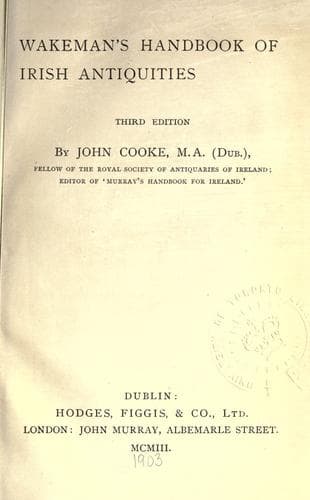
Wakeman's handbook of Irish antiquitiesWakeman, W. F. (William Frederick)
History
Wakeman's handbook of Irish antiquities
Wakeman, W. F. (William Frederick)
Ireland -- Antiquities
Churches like those described in the last chapter, we have every reason
to believe, were constructed before the Anglo-Norman invasion of this
kingdom. How long the style continued is a matter of uncertainty. We
find in the process of architectural development that the horizontal
lintel appears gradually to have given place to the semicircular
arch-head. The high-pitched roof becomes flattened, the walls lose
much of their massive stone-work character and are generally higher,
and cement appears to have been used. The windows exhibit a slight
recess, or a chamfer, upon the exterior, and are of greater size; a
small bead-moulding is occasionally found extending round an arch
upon the interior. As the style advances, the sides of the doorways,
though still inclined, become cut into a series of recesses, the
angles of which are slightly rounded off. The addition of a slight
moulding--at first a mere incision--upon the piers, would seem to have
suggested pillars. Chevron and other decorations, which in England
are considered to indicate the Norman period, are commonly found; but
they are generally simple lines cut upon the face and soffit of the
arch. Pediments appear; and the various mouldings and other details of
doorways and windows become rich and striking, and, in some respects,
bear considerable analogy to true Norman work. The capitals frequently
represent human heads, the hair of which is interlaced with snake-like
animals. To this style of architecture, which has its own distinctive
characteristics, the term ‘Hiberno- or Irish-Romanesque’ has been
applied. The churches, as a rule, are small in size and simple in
plan, after the manner of the earlier buildings. Horizontal forms,
so strong a feature in the old, are combined with the rounded forms
in the new. The decoration contains elements distinctly belonging to
that ornamentation which is so striking a feature of the metal and
manuscript work of the period. This transition can be traced to the
beginning of the eleventh century, but was not fully developed for a
century later, and would lead, as Petrie says, ‘with every appearance
of probability, to the conclusion that such architecture existed here
previously even to the Norman Conquest of England.’[124]
* * * * *
Public-domain text, read in full here on John Shaqi.
Reviews
Reviews
No reviews yet
Be the first to share your thoughts on this work.
Elsewhere in the archive
Join the Discussion
Join the discussion
Sign in to leave a comment or review.
Sign InorCreate an account