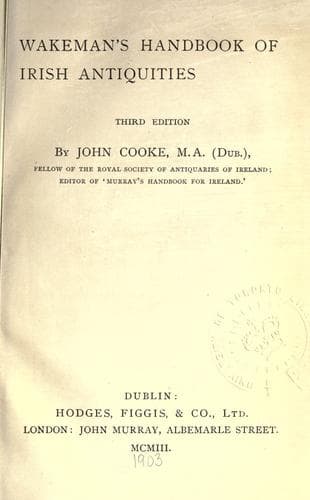
Wakeman's handbook of Irish antiquitiesWakeman, W. F. (William Frederick)
History
Wakeman's handbook of Irish antiquities
Wakeman, W. F. (William Frederick)
Ireland -- Antiquities
In the preceding chapters early churches and other Christian remains
possessing characteristics distinctively Irish have been described. It
has been stated that at the Anglo-Norman Conquest Irish architecture
may be said to have ceased, the invaders having brought with them their
own fashion of building, which was afterwards adopted by the Irish. How
far the stone-roof style of building, which reached its culmination in
King Cormac’s Chapel, could have been carried by builders working on
their own free and independent lines we need not discuss. But never
at any time could it be said that Ireland lay without the sphere of
new influences, as we have tried to indicate in tracing this sketch of
her pagan and early Christian remains. Irish-Romanesque work reached
its highest development in the twelfth century; and during the latter
half, to the beginning of the thirteenth century, a great change was
witnessed in the style of architecture as applied to ecclesiastical
edifices throughout the land.
The rapid growth of the great monastic orders in England in time
affected Ireland. From the Norman Conquest to the close of the reign of
Edward III. it has been computed that 1200 institutions were founded
in England, and of these 228 were established in the reigns of Stephen
and Henry II.--a development which was more or less felt in the
sister kingdom. A complete change was made at this period in the old
monastic system which had existed from the first days of Christianity
in Ireland. This was due to St. Malachy O’Morgair, the friend of St.
Bernard of Clairvaux, and who died there when on a visit to him in
1148. He introduced the Cistercian Order, the greatest builders of all
the Orders, and founded for them the first of their great monasteries
in Ireland. Mellifont was established by St. Malachy in 1142; and
in nine years Bective, Newry, Athlone, Monasteranenagh, Boyle, and
Baltinglas were founded and affiliated to it; and before 1172 we are
told that twenty-five Cistercian monasteries were established in the
land. This is sufficient to show that modifying forces were at work
before the Anglo-Norman invasion touched Irish shores. As we have seen,
for several centuries previous to it, Irish architecture had been
gradually undergoing a development, and had in some measure become
what in England is known as the Norman style. Towards the close of the
twelfth century the Irish kings and chiefs, and the Anglo-Norman earls
and barons settled in Ireland, appear to have vied with each other in
the erection of abbeys, the ruins of which, to this day, attest the
zeal and power of their founders. Most of the monastic structures of
this period, in their larger arches, exhibit beautiful examples of the
earliest Pointed style, while the doorways and smaller openings remain
semicircular, and frequently exhibit pure Norman details. Almost the
last traces of peculiarly Celtic architectural art appear to have died
out in Ireland about the close of the twelfth century.
Public-domain text, read in full here on John Shaqi.
Reviews
Reviews
No reviews yet
Be the first to share your thoughts on this work.
Elsewhere in the archive
Join the Discussion
Join the discussion
Sign in to leave a comment or review.
Sign InorCreate an account