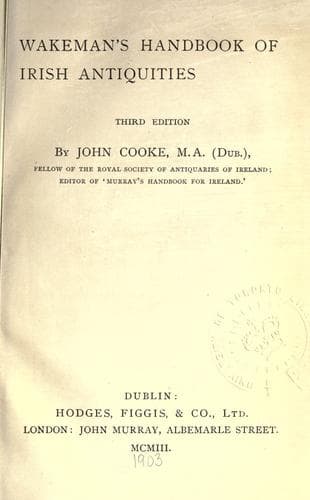
Wakeman's handbook of Irish antiquitiesWakeman, W. F. (William Frederick)
History
Wakeman's handbook of Irish antiquities
Wakeman, W. F. (William Frederick)
Ireland -- Antiquities
_Bective Abbey._--The Abbey of Bective, in the immediate neighbourhood
of Trim, was a Cistercian house, founded by Murchard O’Melaghlin,
Prince of Meath, in A.D. 1146. The ruins exhibit, in a remarkable
degree, a union of ecclesiastical with military and domestic
architecture. Their chief feature is a strong battlemented tower, the
lower apartment of which is vaulted, placed at the south corner of
the quadrangular space occupied by the various buildings, and in the
centre of which the cloisters remain in good preservation. The cloister
arches are late in the First Pointed style, and are cinque-foiled. The
featherings are mostly plain; but several are ornamented with flowers,
or leaves, and upon one a hawk-like bird is sculptured. A fillet is
worked upon each of the clustered shafts by which the openings are
divided, and also upon their capitals. The bases, which are circular,
rest upon square plinths, the angles of which are ornamented with a
leaf, growing, as it were, out of the base moulding. Of the church
there are scarcely any remains. As the northern wall of the cloister
is pierced with several windows which now have the appearance of
splaying externally, it is extremely probable that it also served as
the south wall of the church, no other portion of which can at present
be identified. Those buildings which were devoted to domestic purposes
are, for the most part, situated upon the east side of the quadrangle.
Their architectural details are of a character later than those of the
tower and of the other portions; but additions and alterations have
evidently been made. Several of the apartments have large fireplaces
covered with flat arches, the stones of which are dove-tailed into one
another. The flues are carried up through the thickness of the wall,
and are continued through square tapering chimney-shafts, headed with a
plain cornice. In its general arrangements Bective Abbey differs from
every other monastic structure in Ireland. It is, in fact, a monastic
castle, and, previous to the use of artillery, must have been regarded
as a place of great strength.
The smaller churches of the close of the twelfth, and of the early half
of the thirteenth, century, are not different in general form from
those of an earlier age. In a few examples, indeed, transepts occur, as
in the church of Clady, adjoining Bective; but they are not invariably
evidences of comparatively recent work, being sometimes found in
connection with very early churches, to which they have evidently been
added, and from which, in their architectural details, they differ in
every respect.
Public-domain text, read in full here on John Shaqi.
Reviews
Reviews
No reviews yet
Be the first to share your thoughts on this work.
Elsewhere in the archive
Join the Discussion
Join the discussion
Sign in to leave a comment or review.
Sign InorCreate an account