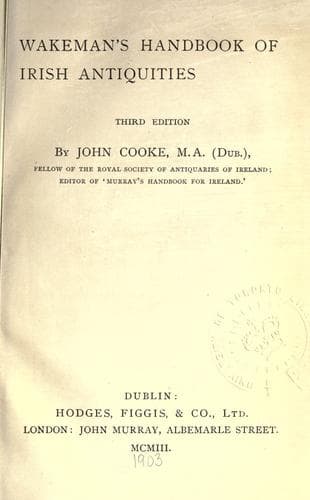
Wakeman's handbook of Irish antiquities — John Shaqi
Wakeman's handbook of Irish antiquitiesWakeman, W. F. (William Frederick)
History
Wakeman's handbook of Irish antiquities
Wakeman, W. F. (William Frederick)
Ireland -- Antiquities
In case of interment the grave was sometimes formed of flags, often
of considerable size, placed edgeways, and enclosing a space, covered
with stones, barely sufficient to contain the body, and over which a
cairn or mound was raised. The body was also deposited in a chamber
formed of large rude stones, often found standing free; but sometimes
the chamber was covered by a mound or cairn, and was accessible by
a passage from without. To the uncovered remains of these burial
structures the name _Cromlech_ is generally applied. The cairn or mound
was often surrounded by a circle of stones, and traces of this still
exist in some of the sepulchral monuments. Sometimes the space in which
the remains of several bodies have been found is barely sufficient for
one body, and it is supposed that they were broken before interment.
Cremated remains are often found with the remains of an interred body;
and this may have been the result of human sacrifices offered to the
manes of the dead.
An interesting account of burial in an upright position is referred to
in the _Book of Armagh_, where King Laoghaire is represented as telling
St. Patrick that his father Niall used to exhort him never to believe
in Christianity, but to retain the ancient religion of his ancestors,
and to be interred in the Hill of Tara, like a man standing up in
battle, with his face turned to the south, as if bidding defiance to
the men of Leinster.
‘Cremations and bodily interments,’ says Colonel Wood-Martin, ‘have
been found intermixed in a manner to lead to the belief that both forms
of burial prevailed contemporaneously. Urns to contain the ashes of the
dead were, possibly, used as a special mark of honour; also, perhaps,
to facilitate the conveyance of the human remains from a distance to
the chosen place of interment. In a country wherein were thick woods
and long stretches of bog to be traversed, the passage of funeral
processions must have been attended with delays and difficulties.’
The ordinary _Cromlech_, when perfect, or nearly so, consists of three
or more stones, unhewn, and generally so arranged as to form a small
enclosure. Over these a large and usually thick stone is placed, the
whole forming a kind of vault or rude chamber. It is generally rude in
appearance, the stones often consisting of mere amorphous blocks. In
Clare, where the limestone is found more or less in a laminated form,
the cromlech becomes more symmetrical, and is often very perfect in
shape.
Public-domain text, read in full here on John Shaqi.
Reviews
Reviews
No reviews yet
Be the first to share your thoughts on this work.
Join the Discussion
Join the discussion
Sign in to leave a comment or review.
Sign InorCreate an account