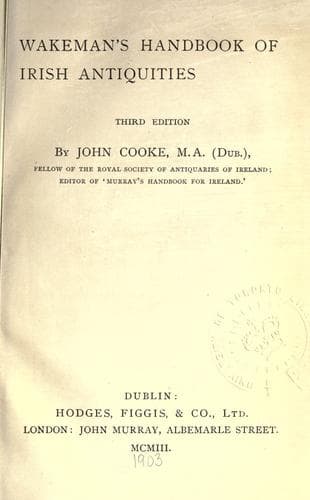
Wakeman's handbook of Irish antiquitiesWakeman, W. F. (William Frederick)
History
Wakeman's handbook of Irish antiquities
Wakeman, W. F. (William Frederick)
Ireland -- Antiquities
The cromlech is usually styled ‘Dolmen’ by English and Continental
writers. Our peasantry, however, as a rule, call them ‘Giants’ Graves,’
or not unfrequently, when retailing a tradition and speaking in Irish,
‘Leaba Diarmida agus Graine,’ or the Beds of Dermot and Graine, from
two historical personages who, according to an old legend, eloped
together, and flying through the country for a year and a day, erected
these ‘beds’ wherever they rested for a night. Graine, or Grace, was
the betrothed wife of Fin Mac Coul, and daughter of King Cormac Mac
Art, who lived about the middle of the third century A.D.; her lover
was Diarmid O’Duibhne, of whom several stories are still current.
According to this legend there should be just 366 cromlechs, or ‘beds,’
in Ireland. But mythical as the story is, it is nevertheless of some
interest, as it connects the monuments with pre-Christian events. In
parts of the north and west of the country they are sometimes styled
‘griddles.’
The true _Chamber Monument_ is an extended form of the cromlech,
and differs from it in that the roof is formed by a succession of
overlapping slabs resting on the stones forming the walls, and
gradually rising from the lower end. The top cap-stone, while resting
on the uprights, not only closes the chamber, but by its weight keeps
in position the overlapping stones which help to support it.
In some cases the covering stone of the cromlech seems to have slipped
from its original position, and will be found with one end or side
resting upon the ground. Du Noyer was of opinion, shared by the late
Mr. Borlase, that this was originally the case in some examples, the
builders having failed in their efforts to raise the ponderous table or
covering stone, or to procure suitable supports. The position of the
upper stone, or roof, is usually sloping; but its degree of inclination
does not seem to have been regulated by any intention or design. This
general disposition of the ‘table’ has been largely seized upon by
advocates of the ‘Druids’ Altar’ theory, as a proof of the soundness
of their opinion that these monuments were erected by the Druids for
the purpose of human sacrifice. Some, indeed, have gone so far as to
discover in the hollows worn by the rains and storms of centuries on
the upper surface of these stones, channels artificially excavated, for
the purpose of facilitating the passage of a victim’s blood earthwards!
Public-domain text, read in full here on John Shaqi.
Reviews
Reviews
No reviews yet
Be the first to share your thoughts on this work.
Join the Discussion
Join the discussion
Sign in to leave a comment or review.
Sign InorCreate an account