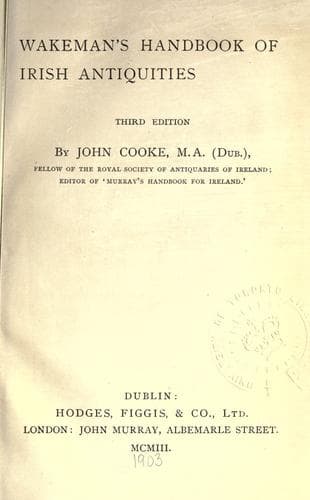
Wakeman's handbook of Irish antiquitiesWakeman, W. F. (William Frederick)
History
Wakeman's handbook of Irish antiquities
Wakeman, W. F. (William Frederick)
Ireland -- Antiquities
The number of these sepulchral remains scattered throughout the country
is very great. Mr. Borlase enumerates them as follows: dolmens,
certain, 780; chambered tumuli, 50; uncertain, 68--total, 898. Of these
dolmens, Connaught has 248; Munster, 234; Ulster, 227; and Leinster,
71. The counties richest in these are--Sligo, 163; Clare, 94; Donegal,
82; and Cork, 71. The area of geographical distribution of these
megalithic monuments is very wide. It extends from western Asia--Syria,
Palestine, and Turkey--over north Africa, through south-east Europe,
France, Spain, Portugal, over north Germany, and northern Europe. In
France they reached a high degree of perfection. England and Wales
furnish many examples similar to the Irish cromlechs; but they are
rarely, if ever, found in Scotland.
The question naturally suggests itself, How were a primitive people,
with such rude mechanical means as they possessed, able to raise those
huge stones into the positions in which they are now found? Several
theories have been advanced, which may be briefly stated. It has been
suggested that the great covering stones of the cromlech having been
found _in situ_, they were undermined, and a chamber formed beneath
by the removal of the earth. As the work progressed uprights were
by degrees placed in position, of sufficient weight and strength to
support the great covering stone. Instances are found in Ireland to
which this theory might, perhaps, apply; but the method could not have
been adopted in such cases as that of the Ballymascanlan cromlech,
where the cap-stone rests on clear supports 8 or 9 feet high. The plan
suggested by the King of Denmark has been accepted by many, and it may
have been adopted in some cases. In this, the supporting stones having
been placed in position, an inclined plane or bank of earth would be
raised, sloping from the level of the uprights to the ground. Up this
the roofing stone would be worked, over blocks of timber placed side
by side, by means of levers, wedges, and haulage. The absence of all
traces of such banks in existing cromlechs, and other considerations,
have been urged against this method of raising these structures. On the
ground that all cromlechs were originally of the ‘giant’s grave’ order,
Mr. Borlase urges the theory that the cap-stones were raised one by
one, the largest first, until it fell into its place upon the highest
uprights. He considers that the disarrangement in the lines of the
side stones, and the presence occasionally of buttresses, support this
view. By using beams of timber and rollers it was possible, with great
and united human strength, to lever very heavy rocks, bit by bit, into
position.
Public-domain text, read in full here on John Shaqi.
Reviews
Reviews
No reviews yet
Be the first to share your thoughts on this work.
Join the Discussion
Join the discussion
Sign in to leave a comment or review.
Sign InorCreate an account