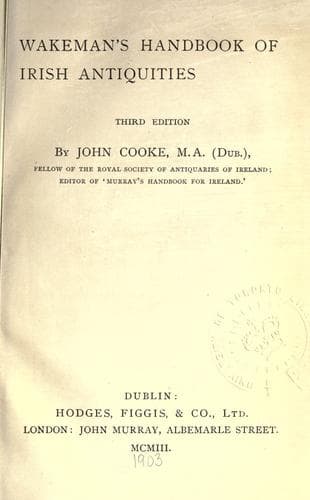
Wakeman's handbook of Irish antiquitiesWakeman, W. F. (William Frederick)
History
Wakeman's handbook of Irish antiquities
Wakeman, W. F. (William Frederick)
Ireland -- Antiquities
The question whether the cromlech was originally covered by a cairn
or mound has been the subject of much discussion, but its full
consideration is outside the limits of this work. The great majority of
existing cromlechs in Ireland are, now at least, of the free-standing
order. Of these some, from the nature of their position and structure,
could never have been the centres of tumuli. Others, no doubt, were
covered; but, in the case of most, time has so altered their condition
that it is now difficult to determine how they really stood in their
original and finished state.[26] A little consideration will show that,
as the cromlech and covered chamber belong to the same general class
of sepulchral monuments, it was intended by the original builders that
access should be had to them from without. Mr. Borlase, agreeing with
Fergusson, is ‘inclined to regard the dolmens as no mere tombs intended
to be closed for ever, but as sacred shrines in which the spirits of
the dead were worshipped, and which were constructed with a view of
being accessible to devotees.’[27] The remains deposited within had
to be protected from the severity of the weather and the intrusion of
wild animals. In the case of the uncovered cromlech all intervening
spaces would be closed up with smaller stones and earth, and the walls
banked up to the edge of the cap-stone. Mr. Borlase advances the
theory that the cromlech, hitherto technically so-called, is the more
megalithic portion of the giant’s grave, and ‘that both types, despite
the difference in their appearance in the condition in which we now
find them, belong to one and the same class of dolmen, originally of
elongated form.’[28] He supports this by pointing out that the ‘giant’s
grave’ is a long, wedge-shaped structure, rising gradually from a
lower to a higher end, the latter having the heavier supports and
larger covering stone. These would be the more difficult to destroy,
for, in the long lapse of time, as stones were required for building or
other purposes, the smaller and lighter would be carried away. How far
this may be the case we cannot here consider; but some cromlechs, such
as those raised of great boulder rocks, could never have been of the
extended order of structure.
Public-domain text, read in full here on John Shaqi.
Reviews
Reviews
No reviews yet
Be the first to share your thoughts on this work.
Join the Discussion
Join the discussion
Sign in to leave a comment or review.
Sign InorCreate an account