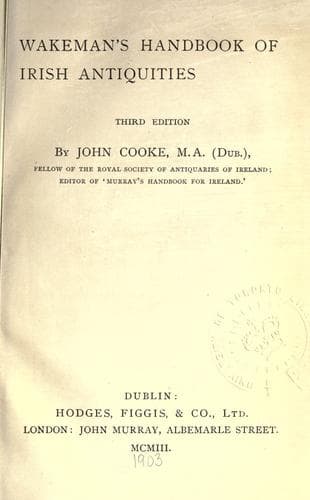
Wakeman's handbook of Irish antiquitiesWakeman, W. F. (William Frederick)
History
Wakeman's handbook of Irish antiquities
Wakeman, W. F. (William Frederick)
Ireland -- Antiquities
_Ballyedmond Chamber_ is ¾ of a mile north-west of Glencullen House,
in the parish of Kilgobbin. O’Curry, writing of it, says: ‘It is a
very fine giant’s grave, resembling the Bed of Callan More on Slieve
Gullion, only that it is more perfect. I doubt if we have met so
perfect a pagan grave in any other counties hitherto examined. This
had been a tumulus, and the earth being cleared away, the grave was to
be seen. The tumulus was oval in shape, and its axis, like that of the
grave, was east and west.’ The side stones of the chamber were ten in
number, one of the covering stones, measuring 7 feet by 5, remained in
its place.
* * * * *
_Shankill Cromlech._--In Cromwell’s _Excursions through Ireland_,
vol. III., p. 159, there is an engraving, after a drawing by Petrie,
of a dolmen at this place, which is situated about four miles to the
north or north-west of Bray, at a distance of a couple of miles from
the nearest point of the sea-shore. O’Neill, writing in 1852, says
that he could not find it, and heard that it had been removed a few
years previously. Nevertheless the monument still exists, and was
sketched by Mr. Wakeman some years ago. It stands by the side of a road
leading across the eastern slope of Carrigollagher, in the direction
of Rathmichael, and is a fair specimen of its class. It retains its
covering stone _in situ_, but without the end stones.
It is interesting to note that the cromlechs in the east of Ireland
are generally of the free-standing and uncovered class. If we want
to find similar monuments to those mentioned, we must seek for them
much further north, or in districts of the west or south-west of
Ireland. It was known that in County Sligo scores of these subaerial
sepulchral monuments were to be found surrounded by one or more lines
of stones, which are not unfrequently associated with free-standing
pillar-stones, and, as would sometimes seem, with elementary
alignments. But, until the appearance of Colonel Wood-Martin’s _Rude
Stone Monuments of Sligo and Achill_, it was not known that in the
west existed T-shaped sepulchres, and others in plan like a dumb-bell,
the handle representing the grave, while the bulbous ends might be
expressed in the form of regularly-constructed stone circles. He
was also enabled to point to triangular graves, a form of burial
structure in Ireland previously described by no other writer. ‘It
is remarkable,’ says Colonel Wood-Martin, ‘that, in the county of
Sligo, the characteristic features of the megaliths varied according
to districts: for example, in Carrowmore the circular form was almost
universal, whereas in Northern Carbury an oblong arrangement appears to
predominate. Again, in the Deerpark Monument, the general architectural
principles displayed at Stonehenge can be traced.’ In the townland
of Carrowmore, to the south-west of Sligo, here referred to, are, or
were, the remains, says Mr. Borlase, of sixty-five ‘dolmen circles,’
Public-domain text, read in full here on John Shaqi.
Reviews
Reviews
No reviews yet
Be the first to share your thoughts on this work.
Elsewhere in the archive
Join the Discussion
Join the discussion
Sign in to leave a comment or review.
Sign InorCreate an account