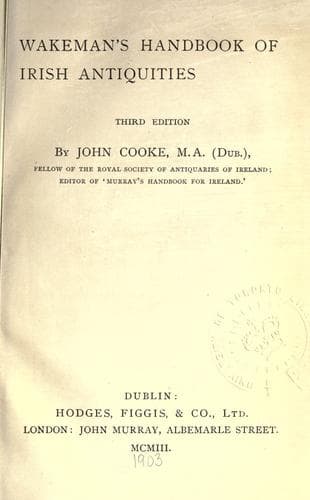
Wakeman's handbook of Irish antiquitiesWakeman, W. F. (William Frederick)
History
Wakeman's handbook of Irish antiquities
Wakeman, W. F. (William Frederick)
Ireland -- Antiquities
forty-four of which are designated in the Ordnance Survey Map. For
particulars of these we must refer the reader to Colonel Wood-Martin’s
survey and Mr. Borlase’s work. Before finally leaving the subject of
the ordinary cromlech it is necessary to notice some examples which
bear markings, seemingly carved with some intention.
* * * * *
_Knockmany Chamber._--This interesting sepulchral monument, which is
illustrated in the frontispiece to this work, is on the summit of a
wooded hill, about two and a half miles north of Clogher, County
Tyrone. The chamber is of the type known as the ‘giant’s grave’; it
lies nearly due north and south, and consists of thirteen stones, most
of which are mill-stone grit. None of the covering stones now remain,
having probably been removed for building purposes. The tomb seems
to have been originally covered by a mound. The internal measurement
is 10 feet 3 inches by 6 feet 6 inches; two of the blocks of the
east side have fallen inwards. Four of the stones have markings,
consisting of cup-hollows, zigzag lines, concentric circles, and other
curved patterns. Expert opinion, from an examination of their forms,
is inclined to associate the markings with the later Bronze Age of
Scandinavia, and to give a probable date of this sepulchral chamber
as 500 B.C. The tomb is known locally as ‘Aynia’s Cove,’ popular
superstition associating it with a witch or hag named Aynia or Ainé.
It is also called Knoc Baine, as being the supposed burial-place of
Baine, mother of Feidhlimidh Reachtmhar, who was king of Ireland early
in the second century. This would bring the monument to the Late Celtic
period, which is difficult to reconcile with the archæological evidence
already mentioned, associating it with the Bronze Age.[35]
* * * * *
_Cloghtogh Cromlech._--Cloghtogh, the ‘Lifted stone,’ is situated close
to the village of Lisbellaw, Co. Fermanagh. It consists of four great
stones, two of which form the sides, and one the end, of a quadrangular
chamber. On the front of the fourth stone, which constitutes the
cap or covering, were four well-marked cups, averaging 1¾ inches in
diameter. These, which unfortunately have been chipped off, were placed
in a horizontal line, extending over a space of 18 inches, and slightly
diminishing in size from left to right. The block is 7½ feet in length,
by 6 feet in breadth, the thickness being 1½ feet.
* * * * *
Public-domain text, read in full here on John Shaqi.
Reviews
Reviews
No reviews yet
Be the first to share your thoughts on this work.
Elsewhere in the archive
Join the Discussion
Join the discussion
Sign in to leave a comment or review.
Sign InorCreate an account