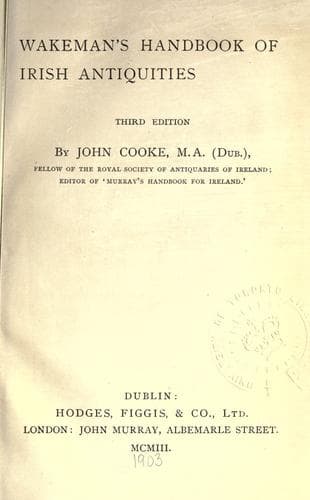
Wakeman's handbook of Irish antiquitiesWakeman, W. F. (William Frederick)
History
Wakeman's handbook of Irish antiquities
Wakeman, W. F. (William Frederick)
Ireland -- Antiquities
This vast cairn which, even in its present condition, measures from the
floor of the inside chamber to the summit 44 feet, and in its greatest
diameter 280 feet, presents, from a little distance, the appearance
of a grassy hill partially wooded; but upon examination the coating of
earth is found to be altogether superficial, and the stones, of which
the hill is entirely composed, can easily be laid bare. The quantity
of stones has been estimated at 100,000 tons. The base is surrounded
by a belt of large blocks of stones eight to ten feet in length, upon
which a dry wall five to six feet in height has been raised. The like
method was adopted in some of the great barrows in England, as in Uley,
in Gloucestershire. A circle of large stones, of which twelve may be
identified, originally surrounded its base, and when Lhwyd saw it,
there was ‘another lesser standing on the top.’ This pillar-stone no
longer exists. The stones stand about thirty feet apart, and if the
circle were completed the original number of stones would be 32. The
area of the mound is about one acre in extent; but if the area of the
circle within the stones be taken, it would extend to two acres.
[Illustration: Plan and Section of Chamber in Newgrange Tumulus.]
[Illustration: Carving on a Stone at the West Recess.]
[Illustration: Ornament on the Roof of the East Recess.]
[Illustration: Ornament on the Roof of the East Recess.]
[Illustration: Scoring on Stone in West Recess.]
The entrance to the gallery is to the south, and across it lies one of
the retaining stones, which is beautifully covered with spirals and
lozenges; two others, also richly carved, have been discovered in the
boundary circle to the north-west. The gallery, which extends in a
direction nearly north and south, communicates with a chamber or cave
nearly in the centre of the mound. This gallery, which measures in
length 63 feet, is, at its entrance from the exterior, 4 feet 9 inches
high; in breadth at the top, 3 feet 2 inches; and at the base, 3 feet
5 inches. These dimensions it fairly retains--except in one or two
places where the stones appear to have been forced from their original
position--and rises gradually to a height of about 6 feet through a
distance of 26 feet from the external entrance. Thence towards the
interior its size gradually increases, but sinks to 4 feet 10 inches at
43 feet, and again rapidly rises by the overlapping of the stones until
it joins the chamber roof. Large blocks of stone, from 5 feet to 8
feet high, and numbering 22 on one side, and 21 on the other, form the
passage. These are Lower Silurian rocks, the formation of the adjoining
district; they show but little traces of the weathering of surface
rocks, ‘but, on the contrary, even faces, which indicate that they have
been split along the cleavage, and care taken in their selection.’
The ground-plan of the chamber is cruciform, the head and arms of the
cross being formed by three recesses, one placed directly fronting
Public-domain text, read in full here on John Shaqi.
Reviews
Reviews
No reviews yet
Be the first to share your thoughts on this work.
Elsewhere in the archive
Join the Discussion
Join the discussion
Sign in to leave a comment or review.
Sign InorCreate an account