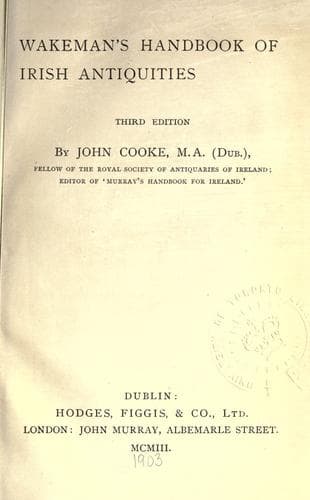
Wakeman's handbook of Irish antiquitiesWakeman, W. F. (William Frederick)
History
Wakeman's handbook of Irish antiquities
Wakeman, W. F. (William Frederick)
Ireland -- Antiquities
_Tumulus at Dowth._--This sepulchral mound corresponds closely to
Newgrange in dimensions; it is about 47 feet high, and measures 280
feet in diameter. Round the base is a belt of large stones as at
Newgrange; but it has no retaining wall. A double circle of stones
appears to have surrounded the cairn. Of these the greater number
lie buried; for in summertime their position, particularly after a
long continuance of sunny weather, is shown by the remarkably dry
and withered appearance of the grass above them. Of the internal
arrangement of this great tumulus, little was known beyond the fact
that it was different from that of the monument last described,
inasmuch as, instead of one great gallery leading directly towards the
centre of the pile, there appeared here the remains of two passages
in a very ruinous state, and completely stopped up, neither of which,
however, seemed to have conducted towards a grand central chamber. The
Committee of Antiquities of the Royal Irish Academy having, in the
course of the autumn of 1847, obtained permission from the trustees
of the Netterville Charity, the proprietors of the Dowth estate, to
explore the interior of the tumulus, the work was commenced and carried
on at considerable cost, under the immediate direction of Mr. Frith,
one of the county surveyors. Unfortunately no official record of the
work done has been kept, and the only account of it is a brief one
by Sir Wm. Wilde. Commenting on this, Mr. George Coffey says: ‘The
mound was so pulled about by the explorers, and the work carried out
with such doubtful wisdom, that the Committee seem to have had a not
unnatural shrinking from publicity.’ From the difficulty of sinking
a shaft among the loose, dry stones of which this hill, like that of
Newgrange, is entirely composed, the plan was adopted of making an
open cutting from the base of the mound towards its centre, in order
to arrive at the great central chamber which was supposed to exist.
The first discovery was that of a cruciform chamber upon the western
side, formed of stones of great size, every way similar to those
at Newgrange, and exhibiting the same style of decoration. A rude
sarcophagus, bearing a striking resemblance to that belonging to the
east recess at Newgrange, was found in the centre. It had been broken
into several pieces, but the fragments were all recovered and placed
together, so as to afford a perfect idea of the original form. In
clearing away the rubbish with which the chamber was nearly filled,
the workmen discovered a large quantity of the bones of animals in a
half-burned state, mixed with small shells. A pin of bronze and two
small knives of iron were also picked up. With respect to instruments
of iron being found in a monument of so early a date, we may observe
that, in the _Annals of Ulster_, there occurs a record of this mound,
as well as of several others in the neighbourhood, having been searched
by the Northmen of Dublin as early as A.D. 862: ‘On one occasion
Public-domain text, read in full here on John Shaqi.
Reviews
Reviews
No reviews yet
Be the first to share your thoughts on this work.
Elsewhere in the archive
Join the Discussion
Join the discussion
Sign in to leave a comment or review.
Sign InorCreate an account