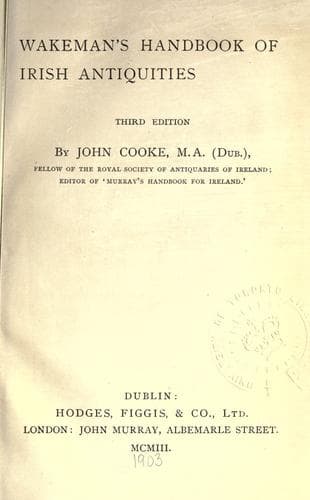
Wakeman's handbook of Irish antiquitiesWakeman, W. F. (William Frederick)
History
Wakeman's handbook of Irish antiquities
Wakeman, W. F. (William Frederick)
Ireland -- Antiquities
inches broad, but separated from the main oval by an immense block of
stone.[50]
[Illustration: Plan of the Deerpark Monument, Co. Sligo.]
This monument was long a puzzle to archæologists. ‘At present it is
unique,’ wrote Fergusson; ‘if some similar example could be discovered,
perhaps we might guess its riddle.’ It remained for Colonel Wood-Martin
to explain the character of this ‘Irish Stonehenge.’ ‘Excavations,’
he writes, ‘made in the four smaller divisions, at the eastern and
western extremities of the monument, clearly demonstrate the fact that
they _had been formerly covered like ordinary kistvaens with roofing
slabs_, as these were found lying in the ground in a fragmentary
state, when the sod was turned up. In these four excavations human and
animal bones were discovered, all uncalcined. With them was a flint
flake. Explorations in the central enclosure were not attended with
equally decisive results; for although in two instances some traces of
osseous remains were found, yet in other spots the soil appeared to
be undisturbed. The conclusion, therefore, may be safely drawn that
the eastern and western “aisles” are simply uncovered kistvaens; that
they were erected when inhumation burial was practised, and when flint
instruments were in use; but whether the central enclosure had been
used for burial, or merely for ceremonial observances before committing
the bodies to the tomb, could not be determined with any degree of
certainty.’[51]
The osseous remains found in various parts of the monument were
submitted to the judgment of several experts, who pronounced them to
be mostly human, and to have belonged to persons of various ages. Some
were evidently those of young children. The bones of the lower animals
noticed comprised those of deer, of the horse (apparently), and some
of swine. There were also bones of rabbits and hares, as likewise some
of birds. All seemed to be strangely mixed together; but the remains
in no instance exhibited the action of fire. It is probable that the
interments were neolithic, and the animal bones the relics of the
funeral feast. The flint flake ‘shows traces of careful chipping for a
short distance round the segment of a circle which forms its cutting
edge, the remainder of the tool being left in a rough unfinished state,
with thick blunt sides.’ It belongs to the class of articles described
by Sir W. Wilde as approaching in form, but not altogether taking the
shape of, a stone celt.[52]
[Illustration: Cairn, on Cairn’s Hill, Co. Sligo.]
* * * * *
Public-domain text, read in full here on John Shaqi.
Reviews
Reviews
No reviews yet
Be the first to share your thoughts on this work.
Elsewhere in the archive
Join the Discussion
Join the discussion
Sign in to leave a comment or review.
Sign InorCreate an account