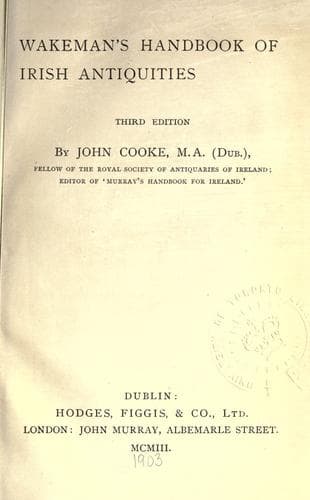
Wakeman's handbook of Irish antiquitiesWakeman, W. F. (William Frederick)
History
Wakeman's handbook of Irish antiquities
Wakeman, W. F. (William Frederick)
Ireland -- Antiquities
In cremation the old neolithic practice was changed with the newer
conception of the relation between the soul and body. This belief was
that the soul could not pass into the spirit world until the body had
been destroyed by burning. Total separation was necessary, and the
quickest and most effective method was through the medium of fire. The
practice was probably an evolutionary one, as in France the process of
the natural destruction of the flesh from the bones, before the latter
were burned, seems in the first instance to have been adopted. Until
the body was destroyed the spirit haunted its local habitation; and the
Homeric idea, shared by the Celt and Norse, was that, when the earthly
tabernacle was consumed, the soul departed for ever to the world of
shades.
Cremation was very probably confined to the chiefs, heroes, or other
important persons, as from the very difficulties attending burning
the ordinary practice of interment was doubtless adopted for the rank
and file of the tribe. Inhumation was practically universal all over
Europe until the close of the Stone Age; but all through the Bronze
Age both customs were practised, and in the west of Europe interment
remained the prevailing custom of disposing of the dead. In the north
of Europe, however, cremation reached a far higher development than
elsewhere. In remote districts of Spain, France, and in the British
Isles the sepulchres of the Stone Age long lingered; and in the tombs
and chambered cairns cremated remains have been found of the later
Bronze Period.
Public-domain text, read in full here on John Shaqi.
Reviews
Reviews
No reviews yet
Be the first to share your thoughts on this work.
Elsewhere in the archive
Join the Discussion
Join the discussion
Sign in to leave a comment or review.
Sign InorCreate an account