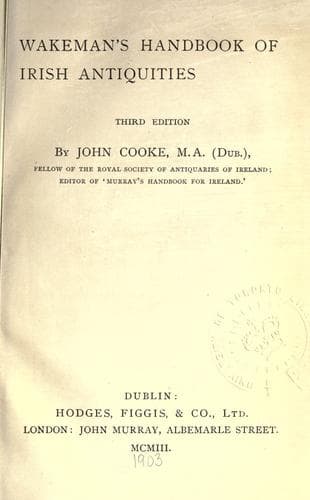
Wakeman's handbook of Irish antiquitiesWakeman, W. F. (William Frederick)
History
Wakeman's handbook of Irish antiquities
Wakeman, W. F. (William Frederick)
Ireland -- Antiquities
_Emania._--We can but briefly refer to a few of the many other motes
celebrated in past times. A residence of the Ulster kings was Emania,
better known as Navan Fort, two miles west of Armagh. It is enclosed
by a rampart, elliptical in shape, which covers an area of about
twelve acres. The east side of the great entrenchment is much cut
away, but the west side is fairly preserved. One of the inner mounds
is comparatively perfect; it measures about 220 feet in diameter,
and rises to a height of 138 feet from the lower base of the fort.
Founded, according to the usual authority, by Queen Macha in 300 B.C.,
it remained for over 600 years the seat of royalty. Here, too, the
Red Branch Knights, whose deeds are celebrated in Irish romance, were
established under King Conor Mac Nessa in the first century.
* * * * *
[Illustration: Rath of Downpatrick.]
_Rath of Downpatrick._--This was known in past times as ‘Rath
Celtchair,’ after a hero of the Red Branch Knights, who dwelt here. It
is one of the finest motes in Ireland, and consists of a mound 60 feet
high, 2100 feet in circumference, surrounded by triple ramparts, one of
which is 30 feet wide.
* * * * *
_Hill of Ward._--The Hill of Ward, near Athboy, was the site of the
Palace of Tlachtga, where the great festival of Samhain, the end of
summer (Nov. 1st), was celebrated. Here the sacred fire was lighted,
and sports and games held for three days before the eve of the festival
and for three days after. At Teltainn, now Teltown, was another great
palace where, from a remote period, a great fair was held on August
1st, instituted, it is said, by Lewy, in honour of his foster-mother,
Taillte, daughter of the King of Spain. Games of all kinds were
celebrated, and chance marriages made, some of which practices came
down to modern times.
* * * * *
_Naas Rath._--The great rath at Naas was the ancient seat of the kings
of Leinster, the place of assembly of the chiefs of the province, and
continued so until the tenth century. The Hill of Allen, about eight
miles to the west, was another seat of the Leinster kings. Here, we
are told, dwelt Fin Mac Coul and his companions in the reign of Cormac
Mac Art; but the remains of the old mound were nearly destroyed when
erecting the modern monument on the summit of the hill. About the same
distance south-west of Naas was Dun Aillinne, a third of the royal
seats of Leinster. This crowned the Hill of Knockaulin, and the earthen
rampart of the fort still surrounds its summit. Many of the motes were
used also as places of burial, and we find recorded instances of such
within the mound. Remains of burials have frequently been discovered;
and these have a special significance to which we have referred in the
previous chapter.
* * * * *
Public-domain text, read in full here on John Shaqi.
Reviews
Reviews
No reviews yet
Be the first to share your thoughts on this work.
Elsewhere in the archive
Join the Discussion
Join the discussion
Sign in to leave a comment or review.
Sign InorCreate an account