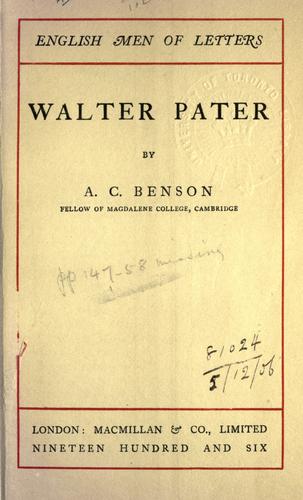
Authors, English -- 19th century -- Biography; Critics -- Great Britain -- Biography; Pater, Walter, 1839-1894
“I find a store of general interest in _Amiel_, (take at random,
_e.g._, the shrewd criticism of Quinet,) which must attract all
those who care for literature; while for the moralist and the
student of religion he presents the additional attraction of yet
another thoroughly original and individual witness to experiences
on the subject they care most for. For myself, I gather from your
well-meditated introduction, that I shall think, on finishing the
book, that there was still something _Amiel_ might have added to
those elements of natural religion, (so to call it, for want of
a better expression,) which he was able to accept, at times with
full belief, and always with the sort of hope which is a great
factor in life. To my mind, the beliefs, and the function in the
world, of the historic church, form just one of those obscure but
all-important possibilities, which the human mind is powerless
effectively to dismiss from itself; and might wisely accept, in the
first place, as a workable hypothesis. The supposed facts on which
Christianity rests, utterly incapable as they have become of any
ordinary test, seem to me matters of very much the same sort of
assent we give to any assumption, in the strict and ultimate sense,
moral. The question whether those facts were real will, I think,
always continue to be what I should call one of the _natural_
questions of the human mind.”
In connection with this frame of mind we may quote an interesting
passage which occurs in the _Greek Studies_ (“The Bacchanals of
Euripides”). He is speaking of Euripides, at the end of a long life of
varied emotion and experience; he says:—
“Writing in old age, he is in that subdued mood, a mood not
necessarily sordid, in which (the shudder at the nearer approach
of the unknown world coming over him more frequently than of old)
accustomed ideas, conformable to a sort of common sense regarding
the unseen, oftentimes regain what they may have lost, in a man’s
allegiance. It is a sort of madness, he begins to think, to differ
from the received opinions thereon. Not that he is insincere or
ironical, but that he tends, in the sum of probabilities, to dwell
on their more peaceful side; to sit quiet, for the short remaining
time, in the reflexion of the more cheerfully lighted side of
things; and what is accustomed—what holds of familiar usage—comes
to seem the whole essence of wisdom, on all subjects; and the
well-known delineation of the vague country, in Homer or Hesiod,
one’s best attainable mental outfit, for the journey thither.”
Public-domain text, read in full here on John Shaqi.
Reviews
Reviews
No reviews yet
Be the first to share your thoughts on this work.
Elsewhere in the archive
Join the Discussion
Join the discussion
Sign in to leave a comment or review.
Sign InorCreate an account