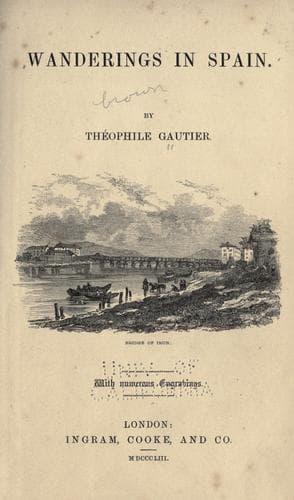
Gautier, Théophile, 1811-1872 -- Travel -- Spain; Spain -- Description and travel; Spain -- Social life and customs -- 19th century
As they were going along the road, one of the travellers drew a
cigar-case out of his pocket, which his captors had forgotten to
search, takes a cigar, strikes a light, and lights it. "Would you
like a cigar?" he says to the chief bandit, with true Castilian
politeness; "they are real Havannahs." "_Con mucho gusto_,"
replies the bandit, flattered by this mark of attention, and, the
next instant, the traveller and the brigand are standing opposite
each other, cigar against cigar, puffing and blowing away, in
order to light their cigars more quickly. They then commenced a
conversation, and, from one thing to another, the robber, like all
commercial men, began complaining of business: times were hard,
things were in a bad state; many honest people had entered the
profession and spoilt it; the robbers were obliged to wait their
turn to pillage the miserable diligences, and, very frequently,
three or four bands were obliged to fight with one another for the
spoil of the same _galera_, or the same convoy of mules. Besides
this, the travellers, who were sure of being robbed, only took with
them what was absolutely necessary, and wore their worst clothes.
"Just tell me," said he, with a melancholy dejected air, pointing
to his cloak, which was threadbare, and patched all over, and which
would have been worthy of enveloping Probity in person, "is it not
shameful that we should be under the necessity of stealing a rag
like this? Is not my jacket one of the most virtuous description?
Could the most honest man in the world be dressed more shabbily
than I am? It is true that we keep our prisoners as hostages, but
relations, now-a-days, are so hard-hearted, that they cannot be
induced to loosen their purse-strings, so that, at the expiration
of two or three months, we are put to the extra expense of a charge
of powder and shot to blow out our prisoners' brains, which is
always a very disagreeable thing, when you have got accustomed to
their society. In order to do all this, too, we are obliged to
sleep on the ground, eat acorns, which are not always palatable,
drink melted snow, make tremendous journeys on the most abominable
roads, and risk our lives at every moment." So spoke the worthy
bandit, more disgusted with his profession than a Parisian
journalist, when it is his turn to write a _feuilleton_. "But,"
said the traveller, "if your profession does not please you, and
brings you in so little, why do you not follow some other?" "I have
often thought of doing so," replied the robber, "and so have my
comrades as well; but what can we do? We are tracked, pursued, and
should be shot down like dogs, if we were to go near a village. No,
we must continue the same kind of life." The traveller, who was
a man of some influence, remained a moment buried in thought; at
last he remarked, "Then you would willingly give up your present
calling, if you were allowed to benefit by the _indulto_ (if you
were amnestied?)" "Most certainly," answered all the band. "Do
Public-domain text, read in full here on John Shaqi.
Reviews
Reviews
No reviews yet
Be the first to share your thoughts on this work.
Elsewhere in the archive
Join the Discussion
Join the discussion
Sign in to leave a comment or review.
Sign InorCreate an account