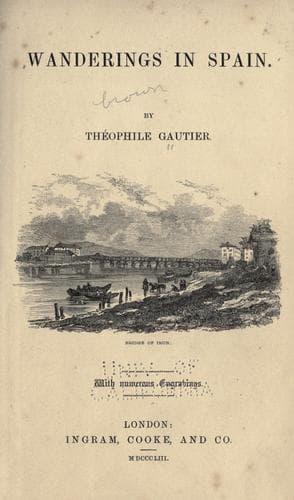
Gautier, Théophile, 1811-1872 -- Travel -- Spain; Spain -- Description and travel; Spain -- Social life and customs -- 19th century
The inn at which we were to pass the night was a large building
consisting but of one immense room, with a fireplace at each end, a
roof of timberwork, shiny and black with smoke, racks on each side
for horses, mules, and donkeys; and having, for the accommodation
of travellers, a few small lateral chambers, containing each a bed
formed of three planks placed on two trestles, and covered with
those pellicles of canvass, in which floated a few lumps of wool,
and which hotel-keepers, with the usual effrontery and _sang froid_
which characterize them, call mattresses; but this, however, did
not hinder us from snoring like Epimenides and the Seven Sleepers
all together.
We set off very early in the morning to avoid the heat, and we
again saw the beautiful rose-bays, as resplendent as glory and
as blooming as love, which had enchanted us the evening before.
The Guadalquiver, with its troubled and yellowish waters, soon
appeared to bar our passage; we crossed it in a ferry-boat, and
took the road to Jaen. To our left was pointed out to us the tower
of Torrequebradilla, on which a sunbeam was playing, and we soon
perceived the strange outline of the city of Jaen, the capital
of the province of that name. An enormous mountain, of the colour
of ochre, as tawny as a lion's skin, variegated with stripes of
red and brown, and enveloped in clouds of light, rises abruptly in
the middle of the city; massive towers, and long, zigzag lines of
fortification streak its barren sides and give them a fantastic
and picturesque appearance. The Cathedral, an immense mass of
architecture, which seems, from a distance, to be larger than the
town itself, rears its head haughtily, like an artificial mountain
by the side of the natural one. This cathedral, which is of the
Renaissance style of architecture, and which boasts of possessing
the true handkerchief in which Saint Veronica took the impression
of our Saviour's face, was built by the duke of Medina Coeli. It
is certainly a handsome building, but we had imagined it, at a
distance, to be both more antique and more curious.
On our way from the _Parador_ to the cathedral, I took care to
inspect the play-bills, and found that, the evening before,
_Mérope_ had been played, and that that evening would be given
"El Campanero de San Pablo," _por el illustrissimo señor don Jose
Bouchardy_; or, in other words, "Le Sonneur de Saint Paul," by my
friend Bouchardy. To have your pieces played at Jaen, a barbarous
town, where the inhabitants never go out without a poniard
in their belt and a carabine on their shoulder, is certainly
very flattering, and very few of our contemporary geniuses are
able to boast of a like success. If we formerly borrowed a few
_chefs-d'œuvre_ of the Spanish stage, we fully repay, at present,
in vaudevilles and in melodramas, the value of all we have taken.
Public-domain text, read in full here on John Shaqi.
Reviews
Reviews
No reviews yet
Be the first to share your thoughts on this work.
Elsewhere in the archive
Join the Discussion
Join the discussion
Sign in to leave a comment or review.
Sign InorCreate an account