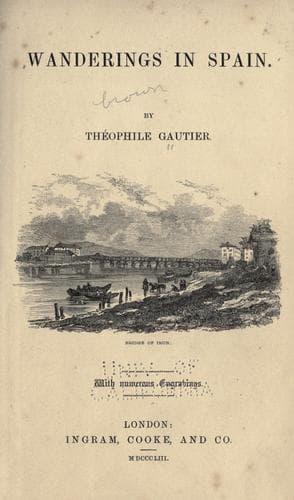
Gautier, Théophile, 1811-1872 -- Travel -- Spain; Spain -- Description and travel; Spain -- Social life and customs -- 19th century
The stranger is astonished at the happy calmness, the
tranquil dignity of the faces he sees around him. No one has that
busy look which is noticeable in the persons hurrying through the
streets of Paris. Every one strolls leisurely along, choosing the
shady side of the street, stopping to chat with his friends, and
betraying no desire to arrive at his destination in the shortest
possible time. The certitude of not being able to make money
extinguishes all ambition: there is no chance of a young man making
a brilliant career. The most adventurous among them go to Manilla
or Havannah, or enter the army, but on account of the piteous state
of the public finances, they sometimes wait for years without
hearing anything about pay. Convinced of the inutility of exertion,
Spaniards do not endeavour to make fortunes, for they know that
such things are quite out of the question; and they therefore pass
their time in a delightful state of idleness, favoured by the
beauty of the country and the heat of the climate.
I saw nothing of Spanish pride; nothing is so deceptive as the
reputation bestowed on individuals and nations. On the contrary,
I found them exceedingly simple-minded and good-natured; Spain
is the true country of equality, if not in words at least in
deeds. The poorest beggar lights his _papelito_ at the _puro_ of a
powerful nobleman, who allows him to do so, without the slightest
affectation of condescension; a marchioness will step, with a
smile, over the bodies of the ragged vagabonds who are slumbering
across her threshold, and, when travelling, will not make a face
if compelled to drink out of the same glass as the _mayoral_, the
_zagul_, and the _escopetero_ of the diligence. Foreigners find
great difficulty in accustoming themselves to this familiarity,
especially the English, who have their letters brought upon
salvers, and take them with tongs. An Englishman travelling from
Seville to Jeres, told his _calesero_ to go and get his dinner in
the kitchen. The calesero, who, in his own mind, thought he was
honouring a heretic very highly by sitting down at the same table
with him, did not make the slightest remark, and concealed his rage
as carefully as the villain in a melodrama; but about three or four
leagues from Jeres, in the midst of a frightful desert, full of
quagmires and bushes, he threw the Englishman very neatly out of
the vehicle, shouting to him as he whipped on his horse: "My lord,
you did not think me worthy of sitting at your table, and I, Don
Jose Balbino Bustamente y Orozco, do not think you good enough to
sit on the seat in my calesin. Good evening!"
Public-domain text, read in full here on John Shaqi.
Reviews
Reviews
No reviews yet
Be the first to share your thoughts on this work.
Elsewhere in the archive
Join the Discussion
Join the discussion
Sign in to leave a comment or review.
Sign InorCreate an account