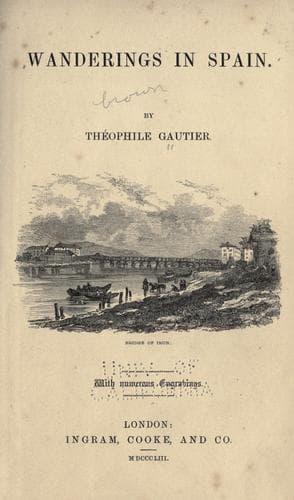
Gautier, Théophile, 1811-1872 -- Travel -- Spain; Spain -- Description and travel; Spain -- Social life and customs -- 19th century
Spanish dramatic authors do not seem to have paid much attention
to the delineation of character, although fine, cutting instances
of observation are to be met with in each scene. But man is not
studied philosophically; and in their dramas you seldom find
those episodical figures so frequent in England's great tragic
poet,--those life-like sketches which are only indirectly connected
with the action of the piece, and have no other object than that
of presenting another phase of the human soul, another original
individuality, or reflection of the poet's mind. The Spanish author
rarely allows the public to perceive anything of his own peculiar
character until he asks pardon, at the conclusion of the drama, for
the faults of which he has been guilty.
The _primum mobile_ in Spanish pieces is the point of honour.
"Los Cusos de la honra son mejores,
Porque mueven con fuerza a toda gente,
Con ellos las acciones virtuosas
Que la virtud es donde quiera amada,"
says Lope de Vega, who was a pretty good judge in the matter,
and did not fail to follow his own precept. The point of honour
played the same part in the Spanish comedies as Fatality did
in the tragedies of the Greeks. Its inflexible laws and cruel
alternatives easily gave rise to dramatic scenes of deep interest.
_El Pundonor_, which was a kind of chivalric religion, with its
own laws, subtleties, and niceties, is far superior to the Ἀνάγκη,
or Fatality of the ancients, whose blow fell blindly, and by mere
chance, on the innocent, as well as on the guilty. When a person
reads the Greek tragic authors, his mind frequently revolts at
the situation of the hero, who is equally guilty, whether he
acts or no; but the point of honour of the Castilians is always
perfectly logical, and consonant with itself. Besides, it is only
an exaggerated representative of all human virtues carried to the
highest pitch of susceptibility. In his most horrible fits of rage,
and in his most frightful acts of revenge, the hero maintains a
noble and solemn attitude. It is always in the name of loyalty,
conjugal fidelity, respect for his ancestors, and the honour of
his name, that he draws his iron-hilted sword, frequently against
those whom he loves with all his soul, and whom he is compelled by
stern necessity to immolate. From this struggle of the passions
with the point of honour springs the interest of most of the pieces
of the old Spanish theatre, a profound and sympathetic interest
keenly felt by the spectators, who in a similar position would
not have acted otherwise than the personages of the drama. We can
no longer be astonished at the prodigious fertility of the old
dramatists of the Peninsula, when we reflect upon the inexhaustible
nature of their subject, which was so well suited to the manners
of the times. Another source of interest, not less rich, was found
in virtuous actions, chivalric devotion, sublime self-abnegation,
Public-domain text, read in full here on John Shaqi.
Reviews
Reviews
No reviews yet
Be the first to share your thoughts on this work.
Elsewhere in the archive
Join the Discussion
Join the discussion
Sign in to leave a comment or review.
Sign InorCreate an account