Gautier, Théophile, 1811-1872 -- Travel -- Spain; Spain -- Description and travel; Spain -- Social life and customs -- 19th century
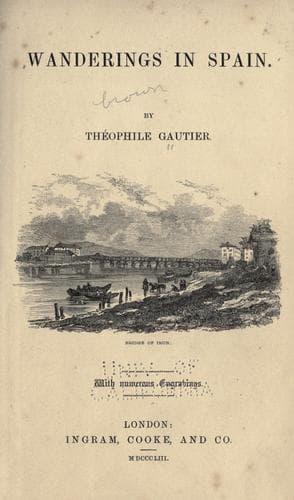
A bridge across the Guadalquivir, which at this point is tolerably
broad, leads into Cordova as you come from Ecija. Close to it are
the ruins of some ancient arches, and of an Arabian aqueduct. The
head of the bridge is defended by a large square embattlemented
tower, supported by casemates of a more recent date. The city
gates not being yet open, a large collection of carts drawn by
oxen majestically crowned with tiaras of yellow and red spartum,
mules and white asses loaded with chopped straw, countrymen with
sugar-loaf hats, and brown woollen _capas_, which fell down before
and behind like a priest's cape, and which are put on by thrusting
your head through a hole made in the middle, were all waiting with
the calmness and patience peculiar to Spaniards, who never appear
to be in a hurry. A similar crowd at one of the Paris Barriers
would have created a horrible disturbance, and given vent to all
sorts of invectives and abuse, but here we heard no other noise but
the tinkling of the brass bell attached to the collar of some mule,
and the silvery sound of that hung round the neck of the _coronel_
ass changing his position, or resting his head upon the neck of one
of his long-eared brethren.
We took advantage of this temporary stoppage to examine, at our
leisure, the external aspect of Cordova. A handsome gateway, like a
triumphal arch, of the Ionic order, and of such good taste that it
might be supposed to be of Roman origin, forms a majestic entrance
to the city of the Caliphs, although I should prefer one of those
beautiful Moorish arches, shaped like a heart, similar to those
you see at Granada. The Cathedral Mosque rises above the outer
walls and the roofs of the town more like a citadel than a temple,
with its high walls denticulated with Arabian embrazures, and its
heavy Catholic dome cowering on the Oriental platform. It must be
confessed that the walls are daubed over with a very abominable
yellow. Without being precisely one of those who admire mouldy,
black, leprous-looking edifices, I have a particular horror of
that infamous pumpkin colour which possesses such attractions for
the priests, the chapters, and the vestry-boards of all countries,
since they never fail disfiguring with it the marvellous edifices
confided to their care. These buildings always should be, and
always have been painted even during the purest periods of the art,
only the peculiar shade and nature of the coating they receive
ought to be selected with more taste. At last the gates were open,
and we had the preliminary gratification of being searched rather
strictly by the custom-house officers; after which, we were at
liberty to proceed, accompanied by our luggage, to the nearest
_parador_.
Public-domain text, read in full here on John Shaqi.
Reviews
Reviews
No reviews yet
Be the first to share your thoughts on this work.
Elsewhere in the archive
Join the Discussion
Join the discussion
Sign in to leave a comment or review.
Sign InorCreate an account