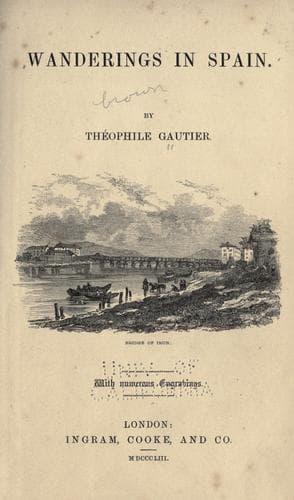
Gautier, Théophile, 1811-1872 -- Travel -- Spain; Spain -- Description and travel; Spain -- Social life and customs -- 19th century
The sacristies are overflowing with treasures; they are literally
crammed full of monstrances glittering with precious stones, silver
reliquaries of enormous weight and incredible workmanship, and as
large as small cathedrals, candlesticks, gold crucifixes, and copes
embroidered with pearls, the whole forming a collection that is
more than royal, and altogether Asiatic.
As we were on the point of leaving the building, the beadle, who
had served as our guide, led us mysteriously into a remote obscure
corner, and pointed out, as an object of the greatest possible
curiosity, a crucifix, which is said to have been carved by a
Christian prisoner, with his nail, on a porphyry column, to the
foot of which he was chained. To prove the authenticity of the
story, he showed us the statue of the poor captive some few paces
off. Without being more Voltairean than is necessary in the matter
of legends, I can not help thinking that people must formerly
have had very hard nails, or that porphyry was extremely soft.
Nor is this crucifix the only one of its kind; there is a second,
on another column, but it is far from being so well formed. The
beadle likewise showed us an enormous ivory tusk, suspended from
the middle of the cupola by iron chains, and looking like the
hunting-horn of some Saracenic giant of some Nimrod of the world
that has disappeared: this tusk is said to have belonged to one
of the elephants employed in carrying the materials during the
building of the mosque. Being well satisfied with our guide's
explanations and complaisance, we gave him one or two small coins,
a piece of generosity which appeared to be highly displeasing to
Jose Maria's old friend, who had accompanied us, and elicited from
him the following slightly heretical remark:--"Would it not be
better to give that money to some brave bandit, than to a villanous
sexton?"
On leaving the cathedral, we stopped for a few moments before a
pleasing Gothic portal, which serves as a façade to the Foundling
Hospital. Anywhere else it would be admired, but, in its present
position, it is crushed by its formidable neighbour.
After we had visited the cathedral, there was nothing more to keep
us at Cordova, which is not the liveliest place in the world to
stop at. The only amusement a stranger can take, is to bathe in the
Guadalquiver, or get shaved in one of the numerous shaving-shops
near the mosque; the operation is very dexterously performed, with
the aid of an enormous razor, by a little barber perched upon the
back of the large oaken arm-chair in which the customer is seated.
[Illustration: MOORISH MILLS, CORDOVA.]
Public-domain text, read in full here on John Shaqi.
Reviews
Reviews
No reviews yet
Be the first to share your thoughts on this work.
Elsewhere in the archive
Join the Discussion
Join the discussion
Sign in to leave a comment or review.
Sign InorCreate an account