Gautier, Théophile, 1811-1872 -- Travel -- Spain; Spain -- Description and travel; Spain -- Social life and customs -- 19th century
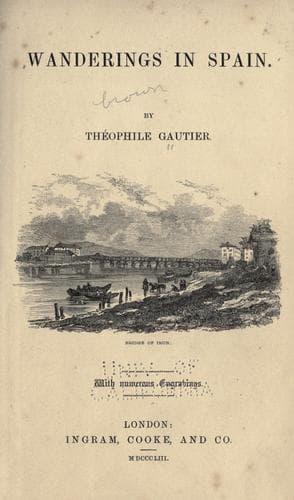
A bridge of boats unites the two banks, and connects the suburbs
with the town. You cross it in order to visit, near Santi-Pouce,
the remains of Italica, the birthplace of the poet Silius Italicus,
and the emperors Trajan, Adrian, and Theodosius: there is a ruined
circus, whose form is still tolerably distinct. The cellars
where the wild beasts were confined, the dressing-rooms of the
gladiators, as well as the lobbies and rows of benches, can be made
out with the greatest facility. The whole is built of cement, with
flint-stones embedded in it. The stone coating has probably been
torn away to serve in more modern edifices, for Italica has long
been the quarry of Seville. A few chambers have been cleared out,
and afford a shelter during the great heat of the day to herds of
blue pigs, who run grunting between the visitors' legs, and are
now the only inhabitants of the old Roman city. The most perfect
and most interesting vestige of all this splendour that has for
ever disappeared, is a large mosaic, which has been surrounded
by walls, and represents Muses and Nereids. When it is revived
with water, its colours are still very brilliant, although the
most valuable stones have been torn out from motives of cupidity.
Among the rubbish, some fragments of very tolerable statues have
likewise been found, and there is no doubt that skilfully directed
excavations would lead to important discoveries. Italica is
situated about a league and a half from Seville, and the excursion
there and back may be easily made with a calessin in an afternoon,
unless you are a furious antiquary, and wish to examine, one by
one, all the old stones suspected of an inscription.
The _Puerta de Triana_, also, has pretensions to Roman origin, and
derives its name from the emperor Trajan. Its appearance is very
stately; it is of the Doric order, with coupled columns, and is
ornamented with the royal arms and surmounted by pyramids. It has
its own alcade, and serves as a prison for gentlemen.
The _Puertas del Carbon_ and _del Aceite_ are worthy of a visit. On
the _Puerta de Jeres_ is the following inscription:
Hercules me edifico,
Julio Cesar me coesco,
De Muros y torres altas
El rey santo me gano
Con Garci Perez de Vargas.
Seville is surrounded by a continuous line of embattlemented walls,
flanked at intervals by large towers, many of which are at present
in ruins, and also by ditches, almost entirely choked up. These
walls, which would not afford the least protection against modern
artillery, produce, with their denticulated Arabic embrasures, a
very picturesque effect. They are said to have been begun, like all
other walls and camps that ever existed, by Julius Cæsar.
Public-domain text, read in full here on John Shaqi.
Reviews
Reviews
No reviews yet
Be the first to share your thoughts on this work.
Elsewhere in the archive
Join the Discussion
Join the discussion
Sign in to leave a comment or review.
Sign InorCreate an account