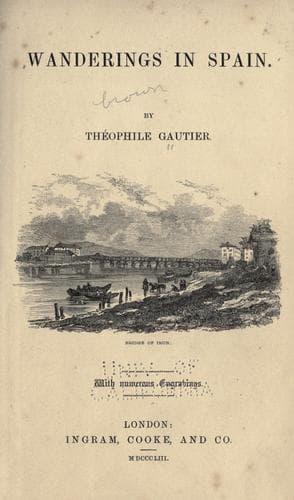
Gautier, Théophile, 1811-1872 -- Travel -- Spain; Spain -- Description and travel; Spain -- Social life and customs -- 19th century
Jeres, like all the small towns of Andalusia, is whitewashed from
head to foot, and has nothing remarkable in the way of buildings,
save its _bodegas_, or wine warehouses, immense structures,
with tiled roofs and long white walls devoid of windows. The
gentleman to whom the letter was addressed was absent, but it
produced its desired effect in spite of this circumstance, and
we were immediately ushered into the cellars. Never was a more
glorious spectacle presented to the gaze of a toper; we walked
through alleys of casks, of four or five stories high. We were
under the necessity of tasting every wine there, at least all the
principal kinds, and there is an infinity of principal kinds. We
ran through the whole gamut, from the sherry that was eighty-four
years old, dark and thick, having the flavour of Muscat, and the
strange colour of the green wine of Béziers, down to the dry,
pale straw-coloured sherry, with a flavour of gun-flints, and a
resemblance to Sauterne. Between these two extreme notes, there
is a whole register of intermediate wines, with tints like burnt
topazes or orange peel, and an extreme variety of taste. They
are all, however, more or less mixed with brandy, especially
those intended for England, where they would not otherwise be
found strong enough, for, to please English throats, wine must be
disguised as rum.
After so complete a study of the Œnology of Jeres, the difficulty
was to regain our carriage with a sufficiently upright and majestic
bearing, so as not to compromise France in the eyes of Spain; it
was a question of national pride; to fall or not to fall, that
was the question on the present occasion, a question which was
rather more embarrassing than that which so greatly perplexed the
Prince of Denmark. I must say, however, with a degree of very
legitimate self-approbation, that we walked to our calessin in a
very satisfactory state of perpendicularity, and represented our
well-beloved country with great glory in this struggle with the
most heady wine of Spain. Thanks to the rapid evaporation produced
by a heat of thirty-eight or forty degrees, on our return to
Puerto, we were perfectly capable of discussing the most delicate
points of psychology, and duly appreciating the various incidents
of the bull-fight. Most of the bulls were _embalados_, that is
to say, they had balls at the ends of their horns; two only were
killed, but we were highly amused by a variety of burlesque
episodes with which the proceedings were enlivened. The picadores,
who were dressed like Turks at a masquerade, with Mameluke trousers
of cambric muslin, and large suns on the back of their jackets,
reminded us most forcibly of those outrageous Moors whom Goya
represents with three or four strokes of the graver in his plates
of the _Toromaquia_. One of these worthies, while waiting for his
turn to attack the bull, blew his nose in the end of his turban
with the most admirable philosophy and coolness. A _barco de
Public-domain text, read in full here on John Shaqi.
Reviews
Reviews
No reviews yet
Be the first to share your thoughts on this work.
Elsewhere in the archive
Join the Discussion
Join the discussion
Sign in to leave a comment or review.
Sign InorCreate an account