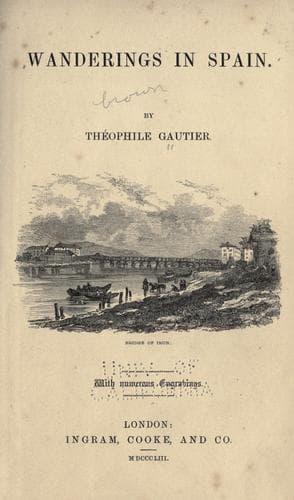
Gautier, Théophile, 1811-1872 -- Travel -- Spain; Spain -- Description and travel; Spain -- Social life and customs -- 19th century
for an indefinite period. When there are two chameleons on the
same rope, the sight becomes most transcendentally ridiculous.
Spleen itself would die of laughter on seeing the horrible looks
of the ugly brutes when they meet. I was exceedingly anxious to
provide myself with the means of indulging in this amusement when
I returned to France, and accordingly bought a couple of these
amiable animals, which I put in a cage. But they caught cold during
the passage, and died of disease of the lungs, on our arrival
at Porte Vendres. They had dwindled completely away, and their
poor little anatomical system peeped out from their shrunken and
wrinkled skin.
Some few days later, the announcement of a bull-fight--the last,
alas! that I was destined to witness--caused me to return to Jeres.
The circus at Jeres is very handsome and very capacious, and is
not without a certain monumental appearance. It is built of brick,
faced at the sides with stone, which produces a pleasing effect.
There was an immense, motley, variegated, ever-moving crowd, and
an endless flourishing of fans and handkerchiefs. In the middle
of the arena was a stake with a kind of little platform upon the
top. On this platform was crouched a monkey, dressed up as a
troubadour, making faces and licking his chaps. He was fastened
by a tolerably long chain, which allowed him to describe a pretty
large circle, of which the stake formed the centre. When the bull
entered, the first object that attracted his attention was the
monkey upon his perch. A most amusing comedy followed. The furious
animal commenced butting violently against the stake, and shook
our friend the monkey in a terrible fashion. The latter was in an
awful state of alarm, which he expressed by the most irresistibly
comic grimaces. Sometimes, being unable to hold on to his plank,
although he grasped it with his four paws, he actually fell upon
the bull's back, where he stuck with all the energy of despair.
The hilarity of the public knew no bounds, and fifteen thousand
smiles lighted up all the swarthy faces around. But the comedy was
succeeded by a tragedy. A poor negro helper, who was carrying a
basket filled with fine earth to sprinkle over the pools of blood,
was attacked by the bull, whom he imagined was occupied somewhere
else, and thrown up twice into the air. He lay stretched out upon
the ground, motionless and lifeless. The _chulos_ came and waved
their cloaks before the bull, and drew him off to another part of
the arena, in order that the negro's body might be carried away.
He passed close to me; two _mozos_ were carrying him by the head
and legs. I remarked a singular fact; from black he had become dark
blue, which is apparently the tint that negroes assume when they
turn pale. This circumstance did not interrupt the proceedings.
_Nada; es un mozo_; "It is nothing, he is only a black;" such
was the funeral oration of the poor African. But if the human
spectators were indifferent to his death, the case was different
Public-domain text, read in full here on John Shaqi.
Reviews
Reviews
No reviews yet
Be the first to share your thoughts on this work.
Elsewhere in the archive
Join the Discussion
Join the discussion
Sign in to leave a comment or review.
Sign InorCreate an account