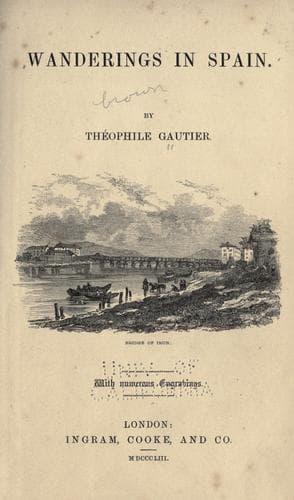
Gautier, Théophile, 1811-1872 -- Travel -- Spain; Spain -- Description and travel; Spain -- Social life and customs -- 19th century
With regard to picturesque appearance, Valencia corresponds pretty
well with the notion formed of it from romances and chronicles.
It is a large, flat, scattered town, laid out in a confused
manner, and possesses none of those advantages that disorder in
construction imparts to old towns built on hilly sites. Valencia
is situated in a plain named the Huerta, in the midst of gardens
and cultivated lands, where constant irrigation keeps everything
cool and fresh--a very rare circumstance in Spain. The climate is
so mild, that palm-trees and orange-trees grow in the open air by
the side of products of the north. Valencia, therefore, carries
on a great trade in oranges, which are measured by being passed
through a ring, like cannon-balls when calibre is required to
be known. Those which cannot pass constitute the choicest. The
Guadalaviar, over which are five handsome stone bridges, and which
is bordered by a superb promenade, runs by the side of the city,
nearly beneath the ramparts. The frequent use made of its waters
for irrigation render these five bridges mere objects of ornament
for three-fourths of the year. The gate of the Cid, through which
you pass to go to the promenade of the Guadalaviar, is flanked with
large embattled towers, which produce a pretty good effect.
The streets of Valencia are narrow, and bordered with high houses
of a sullen aspect, some of which still bear mutilated coats of
arms; you can also perceive fragments of worn-out sculptures,
chimeras without claws, women without noses, and knights without
arms. A casement in the style of the Renaissance, but which is lost
and imbedded in a frightful wall of recent workmanship, causes
from time to time an artist to raise his eyes, and utter a sigh of
regret; you must, however, look for such rare vestiges in obscure
corners, and at the bottom of back-courts, for Valencia itself has
quite a modern aspect. The cathedral, built in a style of hybrid
architecture, possesses nothing, in spite of an apsis with a
gallery furnished with Roman semicircular arches, which can attract
the attention of the traveller after the wonders of Burgos, Toledo,
and Seville. A few finely-sculptured altar-screens, a painting by
Sebastian del Piombo, and another by Espagnoletto, executed in
his softest style, when he was trying to imitate Correggio, are
the only things worthy of remark. The other churches, though both
numerous and rich, are built and decorated in that strange style
of bad ornamentation of which we have already given a description
several times. On beholding all these extravagances, you can
but regret so much talent should have been thrown away on such
subjects. _La Longa de Seda_ (purse of silk) on the market-place,
is a delightful Gothic monument; the grand hall, the vaulted roof
of which rests on rows of pillars with wreathed nervures of extreme
lightness, presents an appearance of elegance and sprightliness
rarely met with in Gothic architecture, which is in general more
Public-domain text, read in full here on John Shaqi.
Reviews
Reviews
No reviews yet
Be the first to share your thoughts on this work.
Elsewhere in the archive
Join the Discussion
Join the discussion
Sign in to leave a comment or review.
Sign InorCreate an account